
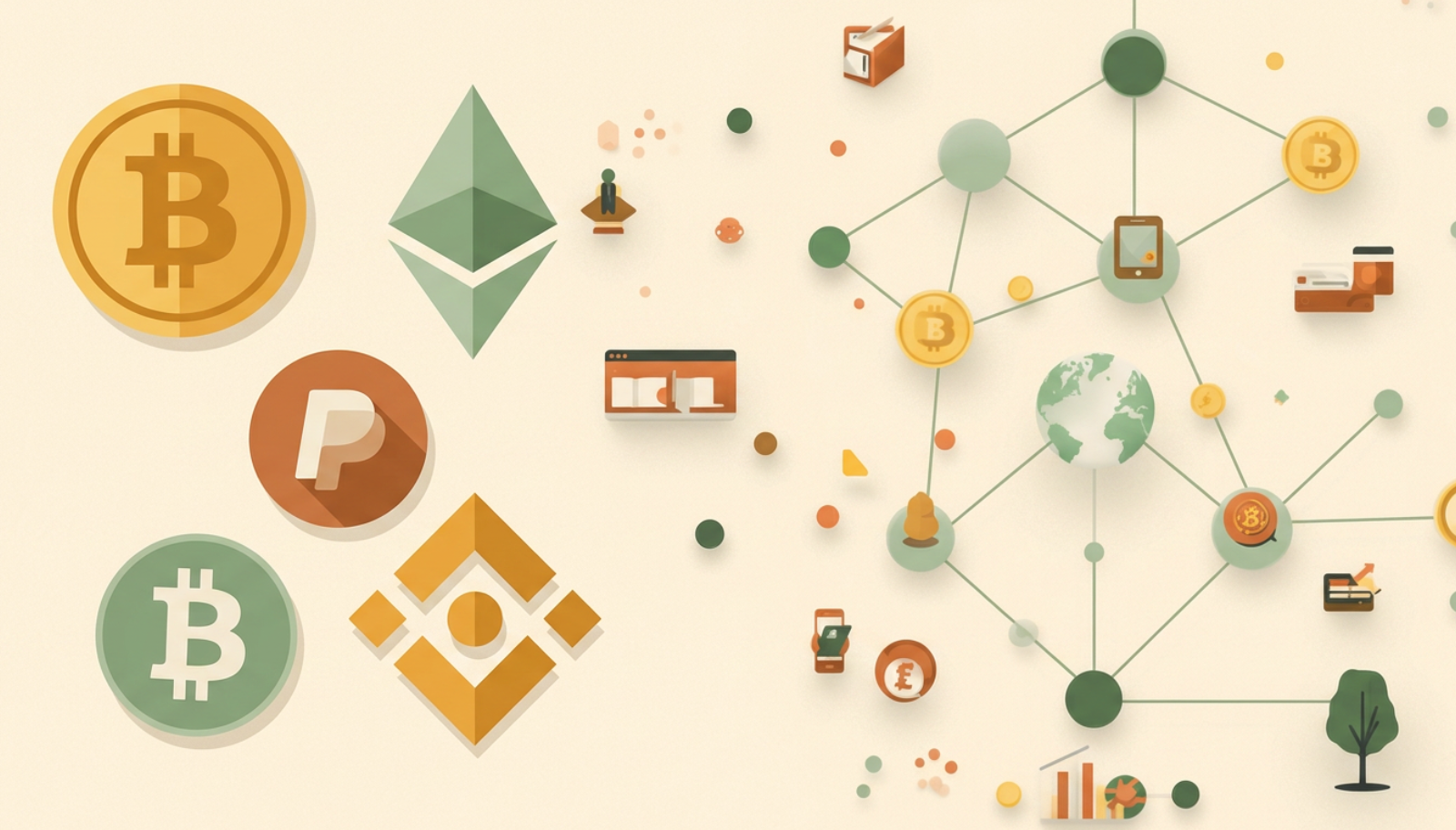
Web 3.0 and cryptocurrencies: how they are changing the world of payments
The signal that something was genuinely shifting in the world of payments came neither from whitepapers nor from specialist forums. It happened when companies like PayPal, Stripe, and Visa started integrating cryptocurrencies into their products, and the traditional financial sector stopped looking the other way.
Web 3.0 is a label for the future of the internet, but not only that. It is the context in which this transformation is taking shape, and payments are perhaps its most concrete point of contact with the daily lives of millions of people.
What we mean by Web 3.0
Clarifying this term is not a minor detail because it is used interchangeably with blockchain, crypto, metaverse, and decentralization, as though they were synonyms. They are not.
Web 1.0 was the web of the 1990s: static pages, read-only content, no interaction. Web 2.0 changed things by introducing participatory platforms, social media, and user-generated content, but at a specific price: centralization. Google, Meta, Amazon, and a handful of others became the custodians of the digital experience, collecting data and building algorithmic monopolies.
Web 3.0 starts from a different premise: ownership of data and digital assets returns to the user, through distributed technologies such as blockchain, smart contracts, and decentralized protocols. Gone is the hub-and-spoke architecture with a few large intermediaries at the center; in its place, a peer-to-peer network where transactions happen directly between parties.
In this model, cryptocurrencies are the economic engine that makes everything sustainable.
The numbers that describe the present
To understand where we stand, it helps to look at the raw data. At the start of 2026, the number of people holding cryptocurrencies worldwide reached approximately 741 million, or 9.1% of the global population. India leads in user count with 127 million holders, followed by the United States with 67 million, up 12 million from 2025.
On the payments front, the figures are even more striking. According to a report published on January 27, 2026, by PayPal and the National Cryptocurrency Association, 39% of US merchants have already implemented cryptocurrency payment options at checkout. Global crypto payment volume in retail is expected to reach $600 billion by the end of 2026, with more than 25 million merchants projected to accept at least one form of digital currency.
Stablecoins, cryptocurrencies pegged to fiat currencies such as the dollar, already account for 60% of all crypto payment activity. This is no coincidence: they offer blockchain technology without exposure to the volatility of speculative currencies.
The side that works: financial inclusion and international remittances
If there is one area where cryptocurrencies have demonstrated a tangible impact, it is international remittances, meaning the money transfers that migrant workers send to their families back home.
The average cost of a traditional remittance still sits at 6.49% of the amount transferred, according to the World Bank in 2025, well above the 3% target set by the UN in its Sustainable Development Goals for 2030. For a worker sending 300 euros a month, that amounts to nearly 20 euros in fees every time, every month, every year.
Stablecoins address this problem structurally. In the US-to-Colombia remittance corridor, for example, the average cost of a blockchain transfer using stablecoins sits between 1.60% and 2.50%, roughly half of what conventional channels charge. No bank account or credit card required: a digital wallet on a smartphone is enough, which opens access to populations historically excluded from the formal financial system.
The geographic growth tells this story clearly. The Asia-Pacific region recorded a 69% year-on-year increase in on-chain activity, Latin America recorded a 63% year-on-year increase, and sub-Saharan Africa saw adoption grow by 19.4% in 2025. These are markets where the traditional banking system has never worked for everyone, and where a peer-to-peer stablecoin transfer solves real problems immediately.
The El Salvador case: an experiment that taught a great deal
A serious discussion of cryptocurrency payments cannot ignore El Salvador. In September 2021, the Central American country became the first in the world to adopt Bitcoin as legal tender alongside the US dollar. The ambition was clear: reduce remittance costs (which account for over 20% of national GDP), promote financial inclusion, and position the country as a pioneer of decentralized finance.
The results, a few years on, tell a more complicated story.
In October 2022, 97.75% of Salvadoran businesses had not made even a single sale in Bitcoin. Four years after the launch, 66% of the population considered Bitcoin a failed project, and 77% believed that public funds should no longer be directed toward supporting it. Only 20% of Salvadorans had ever used the digital currency in any concrete way.
In January 2025, El Salvador removed Bitcoin from mandatory legal-tender status, relegating it to voluntary use in the private sector as a condition set by the International Monetary Fund for a $1.4 billion financial assistance program. The government nonetheless continued purchasing Bitcoin, bringing its strategic reserves to 6,102 coins, worth approximately $500 million as of March 2025.
The lesson is not that cryptocurrencies in payments are pointless, quite the opposite. Imposing technologies with a steep adoption curve on populations unfamiliar with them, without adequate infrastructure and without widespread financial literacy, does not work. Context matters as much as the technology.
The other side: fraud, crime, and volatility
Focusing only on the positive scenarios would give a partial picture. Web 3.0, in its current form, also hosts a sophisticated criminal ecosystem worth billions of dollars.
In 2025, global losses from cryptocurrency fraud and scams reached $17 billion. The average payment per crypto scam victim grew by 253% year on year, rising from $782 to $2,764. Impersonation tactics, in which fraudsters pose as celebrities or institutions to deceive users, recorded 1,400% growth compared to the previous year, driven by the use of generative artificial intelligence to create convincing deepfakes.
The picture gets worse when looking at money laundering: in 2025, illicit addresses received $154 billion in cryptocurrencies, a 162% increase over the previous year. State-sponsored hackers, particularly North Korean groups, stole $2.02 billion in 2025 alone, their highest annual figure on record. Total theft through cyberattacks reached $3.4 billion, up from $2.2 billion in 2024.
A paradoxical data point: stablecoins, the same ones that facilitate low-cost remittances in emerging markets, now account for 84% of the volume transacted toward illicit addresses. The blockchain’s technological neutrality, unfortunately, does not distinguish between virtuous and criminal uses.
Add to this the structural volatility of unpegged cryptocurrencies, which makes their use as a reliable payment method difficult for any transaction with a time horizon longer than a few minutes. Someone who sells a property and gets paid in Bitcoin risks ending up with a substantially different sum of money within a week.
Me and crypto during my time at PayPal
I spent years at PayPal, and for part of that time, I worked on crypto content for the FAQs and knowledge base, managing the editorial governance of materials available to users. As I described in this article, the boundary between content strategy and content design became particularly clear in that context: explaining cryptocurrencies to an average user requires considerable conceptual simplification, because it means translating an entire financial paradigm into accessible language.
The crypto FAQs were not simple questions and answers: they had to explain what a stablecoin was, how private key custody worked, why Bitcoin’s price can move 10% in a day, and what that means for a user’s balance. All in language that assumed no prior technical knowledge, across a dozen or more markets with different sensitivities toward financial regulation.
That work taught me how underrated knowledge management is in a fast-moving technical sector: the quality of the information available to users determines their trust, and trust is the prerequisite for large-scale adoption.
In the meantime, since 2020, I also have a more direct perspective on the crypto world: that of an investor. I built a small portfolio that swings quite a bit, and I experienced firsthand the TerraLuna collapse in May 2022, one of the most damaging events in recent cryptocurrency history. LUNA, the native currency of the Terra ecosystem, fell from around $80 to fractions of a cent within days, dragging down UST, the system’s algorithmic stablecoin that was meant to be “stable” by definition. Real losses, not theoretical ones. That experience changed how I read the sector’s data: with greater awareness of structural risks and less uncritical enthusiasm for any technology that promises to revolutionize everything.
PYUSD: When PayPal decided to have its own stablecoin
In August 2023, PayPal launched PYUSD, a US dollar-pegged stablecoin issued by Paxos Trust Company and initially built on the Ethereum blockchain. The move was significant for a specific reason: this was not a crypto-native company creating a digital currency, but the world’s largest digital payments operator entering the stablecoin space directly.
The strategy evolved quickly. In June 2025, PYUSD was integrated on the Stellar blockchain, designed specifically for fast, low-cost cross-border payments. In April of the same year, PayPal introduced a 3.7% annual yield on PYUSD balances, a mechanism to encourage holding rather than immediate conversion. In December 2025, YouTube enabled US creators to receive advertising revenue directly in PYUSD.
In 2026, the acceleration became clear. In March, PayPal announced the availability of PYUSD across 70 international markets, covering Asia-Pacific, Europe, Latin America, and North America. Market capitalization reached $4.08 billion, with 680% year-on-year growth, the fastest rate among major stablecoins. In February 2026, PYUSDx was launched: a framework allowing developers to issue their own branded stablecoins backed 1:1 by PYUSD reserves.
One element that tends to go unnoticed is that, in December 2025, Paxos obtained federal oversight from the OCC (Office of the Comptroller of the Currency), making PYUSD the largest dollar-backed stablecoin issued by a federally regulated entity in the United States. In the race for institutional legitimacy that defines this sector, that is a competitive advantage far from negligible.
The regulation question
None of the dynamics described so far can be read without considering the regulatory environment, which in 2025 and 2026 finally began to take shape more coherently.
In the United States, the GENIUS Act, signed in summer 2025, established a federal framework for payment stablecoins, introducing reserve requirements, periodic audits, and transparency standards. In Europe, the MiCA regulation (Markets in Crypto-Assets) came fully into force, imposing licensing obligations on cryptocurrency and stablecoin issuers operating in the EU market.
This regulatory convergence is good news for mass adoption: the issue was never that cryptocurrencies lacked valid use cases, but that the absence of clear rules discouraged traditional institutions from integrating technologies for which no shared reference framework existed.
Where things are heading
Payments have always been a mirror of the technology and trust available at any given historical moment. The journey has gone from barter to metal coins, from bills of exchange to credit cards, from SWIFT transfers to digital wallets. Cryptocurrencies and Web 3.0 are not necessarily the final chapter of this story, but they are certainly a new one.
The elements that seem set to solidify are stablecoins in cross-border payments, where the efficiency gains over traditional channels are measurable and documented, and DeFi infrastructure that gives access to credit and financial markets to those who have historically been excluded.
What remains open is the question of widespread trust. As long as the learning curve for using a crypto wallet remains significantly steeper than that for using a debit card, mass adoption will remain limited to those already comfortable with the technology or those with no alternative. As I wrote about live shopping in eCommerce, the technologies that capture mass markets are those that reduce friction to the point of feeling obvious. Cryptocurrency payments have not quite reached that point yet, but they are moving in that direction at a growing pace.
Related sources
- Chainalysis – 2025 Global Crypto Adoption Index
- Chainalysis – 2026 Crypto Crime Report: Scams
- TRM Labs – Q1 2026 Global Crypto Adoption Index
- DemandSage – Global Crypto Adoption Stats 2026
- PayPal Newsroom – PYUSD and Stellar (June 2025)
- PYMNTS – PayPal Scales PYUSD to 70 Countries
- Stablecoin Insider – PYUSD Q1 2026 Report
- Americas Quarterly – El Salvador, Bitcoin’s lessons
- IMF Country Report No. 25/68 – El Salvador (2025)
- PaymentsCMI – Stablecoins and Remittances
- Federal Reserve – Payment Stablecoins and Cross-Border Payments (2026)
- Kroll – The Money Laundering Surge & Crypto Enforcement Gaps
- contentbenefit.com – Content Designer vs. Strategist
- contentbenefit.com – Live shopping: the “new” eCommerce
