
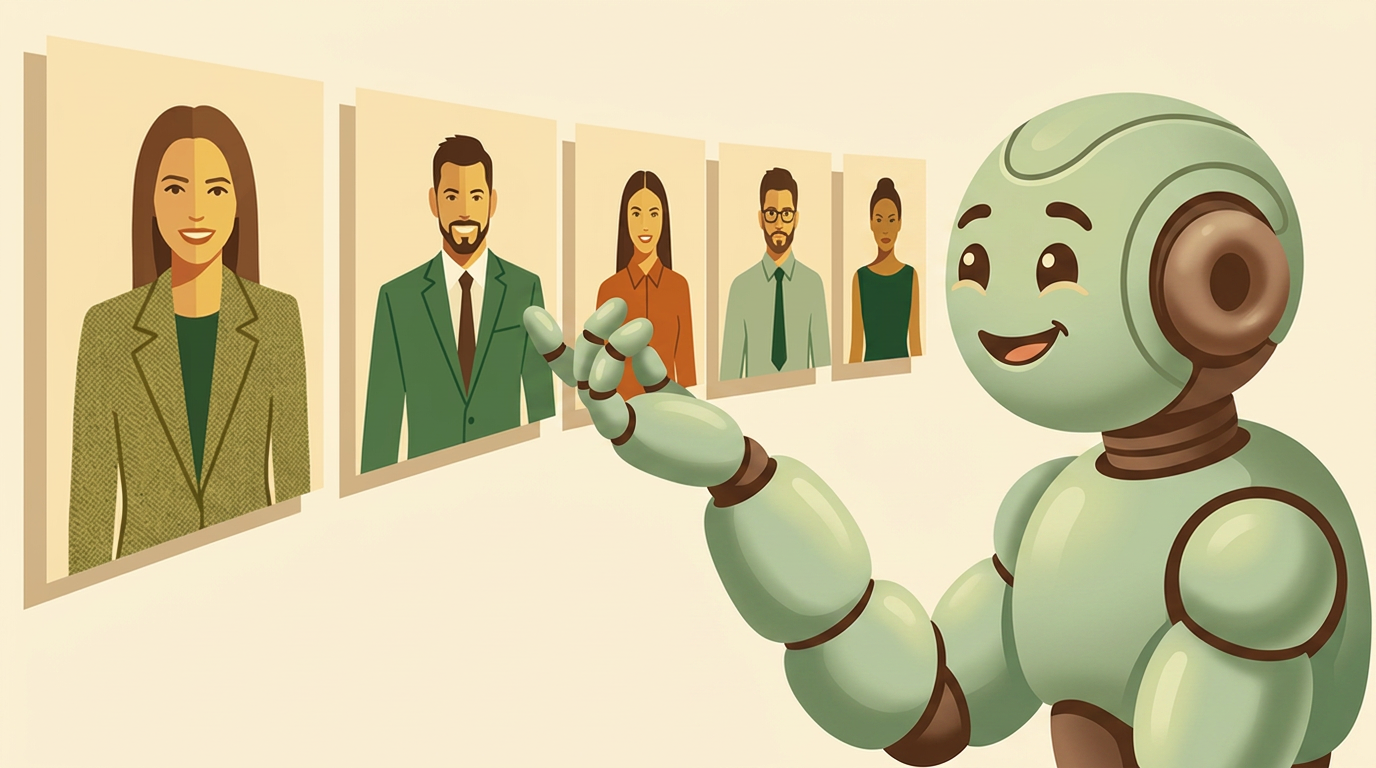
AI job interviews: my experience, between gut feelings and data
Over the past few months, I’ve done several job interviews conducted by an artificial intelligence. No flesh-and-blood recruiter, just a synthetic voice asking questions, listening, summarizing, and thanking me. It’s an experience worth trying at least once, if only to understand where recruiting is headed. I came out of it with mixed feelings, so I went looking for research and numbers to figure out whether my impression was just mine or part of a much wider phenomenon. Spoiler: it’s a very wide one. According to the 2026 Greenhouse candidate report, 63% of American job seekers have already gone through at least one AI interview.
Less emotion, for better and for worse
The first thing I noticed was that you feel calmer. There’s no person on the other side judging you in real time, and you know it. The flip side is that everything else is missing too: eye contact, facial expressions, body language, all those microsignals that tell you whether you’re on the right track or should change course. Anyone who has read my piece on the subtle art of influencing knows how much nonverbal communication matters in a professional conversation. With a bot, that channel is shut.
Research confirms this void carries weight. A study published in Frontiers in Psychology involving 755 job seekers identified “social presence” as the key factor linking AI interview design to how attractive a company appears: when the system feels more human, transparent, and informative, candidates rate the overall experience more positively. When it fails, the effect is exactly what I felt.
The pauses AI cannot read
Then there’s a detail I found almost paradoxical. The AI never interrupts you while you’re speaking, something many human recruiters should learn. But if you pause for a few seconds to find the right word, the system interprets the silence as a final answer and jumps to the next question. It cuts you off precisely when you were about to say your best line. A human interviewer can tell from your gaze that you’re thinking; a voice model, at least for now, can’t.
Positive reinforcement for everyone, feedback for no one
Another constant across my calls: the AI summarizes and validates whatever you say. “Great point”, “thanks for such a thorough answer”. Continuous encouragement that never discriminates: if you go off topic or miss the question entirely, nobody flags it. The responses you do get are brief and often feel dry, and by the end, you’re unsure whether it went well.
Here too, the numbers back me up. In the Frontiers study, feedback informativeness emerges as one of three design elements that shape the perceived quality of the experience, alongside human-likeness cues and decision transparency. And according to Greenhouse, 39% of candidates want to know which criteria they’re being evaluated on, while 38% ask for confirmation that a human reviews what the machine produces.
When the connection drops, the interview dies
A technical glitch during a traditional interview gets handled: someone calls back, you reschedule. With the bot, no. If the connection fails or the system freezes, the conversation stops, and there’s no follow-up. Time wasted, period. One reason, as noted in the Greenhouse report, is that 38% of candidates have withdrawn from hiring processes that included automated interviews.
Ghosting isn’t an exclusively human flaw
I assumed machines would at least beat us at one thing: replying. Instead, 51% of people who complete an AI interview never receive an outcome, according to Greenhouse data, as reported by Fortune via Yahoo Finance. My experience fits the statistic perfectly: in many cases, after the call, total silence. I’ve already covered employer ghosting, and what it costs companies in terms of reputation, in The job hunter’s heartbreak: apparently, handing the calls over to a bot hasn’t fixed the problem. Greenhouse’s chief people officer, Sharawn Tipton, describes it this way: candidates feel “processed rather than considered”.
What academic research says
An experimental study published in Humanities and Social Sciences Communications (Nature portfolio) measured how AI interviews affect willingness to apply: people expecting an automated interview showed a significantly lower intention to apply than those expecting a video call with a person (5.72 versus 6.13 on a 7-point scale). The reason runs through two paths: the automated format is perceived as less procedurally fair, and it makes the company look less appealing as an employer.
The counterargument: maybe it works better than we think
Intellectual honesty requires me to say that I also found evidence pointing in the opposite direction. The largest field experiment ever run on this topic, “Voice AI in Firms” by Brian Jabarian and Luca Henkel, covered roughly 70,000 real applications. The results are surprising: voice-AI interviews increased job offers by 12%, actual job starts by 18%, and 30-day retention by 17%. When given the choice, 78% of applicants picked the bot over the human recruiter. Gender discrimination complaints fell from 5.98% to 3.30%.
On bias, my feeling during the calls was exactly this: AI comes across as less partial, apparently free of prejudice. The field experiment partly proves me right, since measured discrimination declined, even though the candidates surveyed by Greenhouse perceive discrimination at similar rates from human and artificial interviewers alike. One figure struck me above all: only 19% of candidates want less artificial intelligence in hiring. The majority instead asks for more transparency and greater human oversight. The real issue, in short, is the quality of the implementation, a territory that demands skills beyond code, as I wrote in Philosophers and humanists for AI.
My takeaway
At the end of every call with the bot, I was left with a feeling of suspension: no clear impression, no emotion to take home, none of the healthy disappointment of an interview gone wrong. The data show these tools can work and, in some contexts, even outperform people. Until they offer transparency about criteria, a plan for when things break, and feedback that’s worth the name, it will remain half an experience.
Related sources
- 2026 Candidate AI Interview Report, Greenhouse
- Why might AI-enabled interviews reduce candidates’ job application intention? Humanities and Social Sciences Communications (Nature)
- Perceived AI interview design and organizational attractiveness, Frontiers in Psychology
- Voice AI in Firms: A Natural Field Experiment on Automated Job Interviews, Brian Jabarian and Luca Henkel, SSRN
- Nearly 4 in 10 job candidates have bailed on a hiring round because it required an AI interview, Fortune via Yahoo Finance
