
Ninety-six thousand shuttered windows: retail changes its face
There is a street, in the city where I was born, that seemed like an entire world when I was a child: fabric wholesalers, haberdasheries, a hardware store that also sold padlocks for mopeds, two bakeries locked in perpetual competition. Today I walk along it counting the lowered shutters the way you count the cars of a freight train. The same goes for the place where I now live: whole blocks that once buzzed with wholesale and retail activity have shrunk into silent corridors, dotted with “for rent” signs yellowed by the sun. The feeling matches the numbers, which say this is happening everywhere and also explain why.
The Confcommercio figures
The statistic that made the rounds of the Italian press comes from the latest Confcommercio report, covered among others by SoldiOnline: between 2018 and 2025 the country’s points of sale went from 666,479 to 570,313, that is 96,000 fewer, a 14.4% drop in seven years. Widening the lens back to 2012, as the association’s business demographics observatory does, the vanished enterprises become 156,000 in thirteen years, while online sales grew by 187%.
Proximity categories have paid the highest price: street vendors lost 27.3% of their operators, small food shops 17.9%. The decline hits newsstands, fuel stations and clothing hardest, with peaks above 50% for newsagents in some regions. The association calls it “commercial desertification”, and anyone who has walked through a semi-peripheral area of a mid-sized Italian town knows the image is anything but exaggerated.
The revenue paradox
Here comes the counterintuitive part: while signs were going dark, the sector’s overall takings rose by 25.7%. Discounters doubled their turnover (+101.1%), eCommerce gained 41.9%, and hypermarkets, icons of the Nineties, gave up 8.4%. In practice, more gets sold through fewer channels, either bigger or entirely immaterial.
Consumers, meanwhile, have changed as much as the urban landscape: they buy online, including from the Chinese marketplaces now under scrutiny in Europe, compare prices down to the cent, and have learned to spot tricks like the ones described in our piece on shrinkflation hitting your cart. Spending has simply moved to wherever it costs less effort or less money.
A look beyond our borders
The phenomenon reaches far past Italy. In the United States the talk has been of a “retail apocalypse” for years: according to Coresight Research, some 15,000 closures were expected in 2025 alone, double the previous year, against 5,800 openings. In France the so-called vacance commerciale, the share of empty premises, climbed to 10.64% in 2024, with footfall in urban cores down 1.8%, prompting the government to launch a nine-measure recovery package.
The United Kingdom, which has built an entire journalistic genre on the decline of its high streets, offers a signal running the other way: according to Knight Frank, vacant space fell to 13.2% in early 2026, the best level since Covid, and for the first time in years new openings outnumber shutdowns. Chains like John Lewis are pouring hundreds of millions of pounds into their physical estates. The British lesson suggests the downturn can prove a reversible phase, if someone is willing to reinvent the store.
Who stays open when everyone else closes
In the emptied streets of my daily experience, the only outposts still lit in the evening are almost always ethnic minimarkets and Chinese bazaars. Many residents watch them with dismay, as definitive proof that “the neighbourhood isn’t what it used to be”. I understand that feeling, because the disappearance of historic shops also means losing identity and relationships. The figures, though, help read the situation with more lucidity.
Businesses run by foreign citizens in Italy number about 678,000, growing while Italian-owned ones shrink, and over 261,000 of them operate precisely in trade. In Rome, minimarkets managed by Bengali entrepreneurs went from 871 to more than a thousand in a couple of years. Their resilience has very concrete explanations: opening hours covering evenings and holidays, short supply chains often built on community ties, compressed costs, product ranges that large-scale distribution never carried. They occupy, in essence, the economic space traditional retail has abandoned. That unease deserves respect, but it should be directed at the causes of desertification, never at those who had the courage to raise a shutter where others pulled theirs down.
What remains of proximity
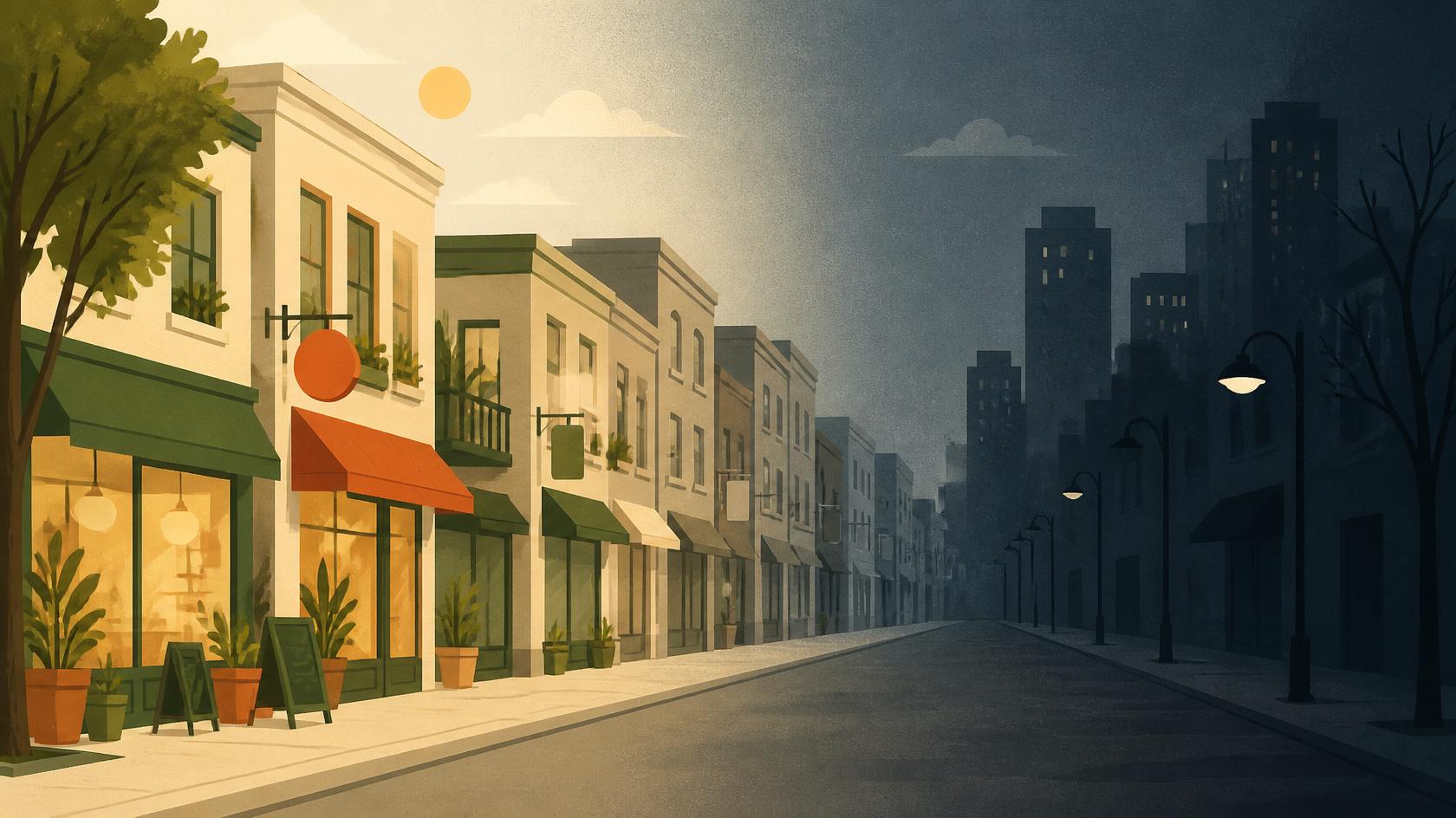
The ongoing transformation looks less like an agony and more like a moulting: retail sheds its skin, and cities with it. Some functions migrate online, others concentrate in discount chains, still others are reborn in new formats, from specialised neighbourhood stores to hybrid concepts. The critical point is what happens to the streets in the meantime: a darkened road is dimmer, less safe, less alive, and the social value of a corner shop appears on no balance sheet. All the more so because vacant premises rarely become shops again: they often turn into delivery depots or tourist flats, with effects that intertwine with the housing crisis in big cities.
Sometimes I open Street View and go back to look at that street as it was ten years ago, a memory ritual I have already described in A Google Street View to memories. Nostalgia, however, achieves little when it stays mere regret. The British experience, and the French revitalisation policies, show that with smart investment and rules urban centres can fill up again. Perhaps under names different from those of our childhood, and maybe that is fine.
Related sources
- Confcommercio: 96mila negozi in meno, ma i consumi cambiano volto, SoldiOnline.it
- Desertificazione commerciale, in 13 anni sparite 156mila attività, Confcommercio
- Confcommercio, sempre meno negozi sul territorio, persi 96mila tra 2018 e 2025, ANSA
- Coresight sees 15,000 U.S. store closings this year, WWD
- Retail renaissance 2026: physical stores are back, Knight Frank
- Les magasins de centres-villes en mal de fréquentation, Banque des Territoires
- Il negozio che non chiude praticamente mai, il blog di Mario Sassi
