
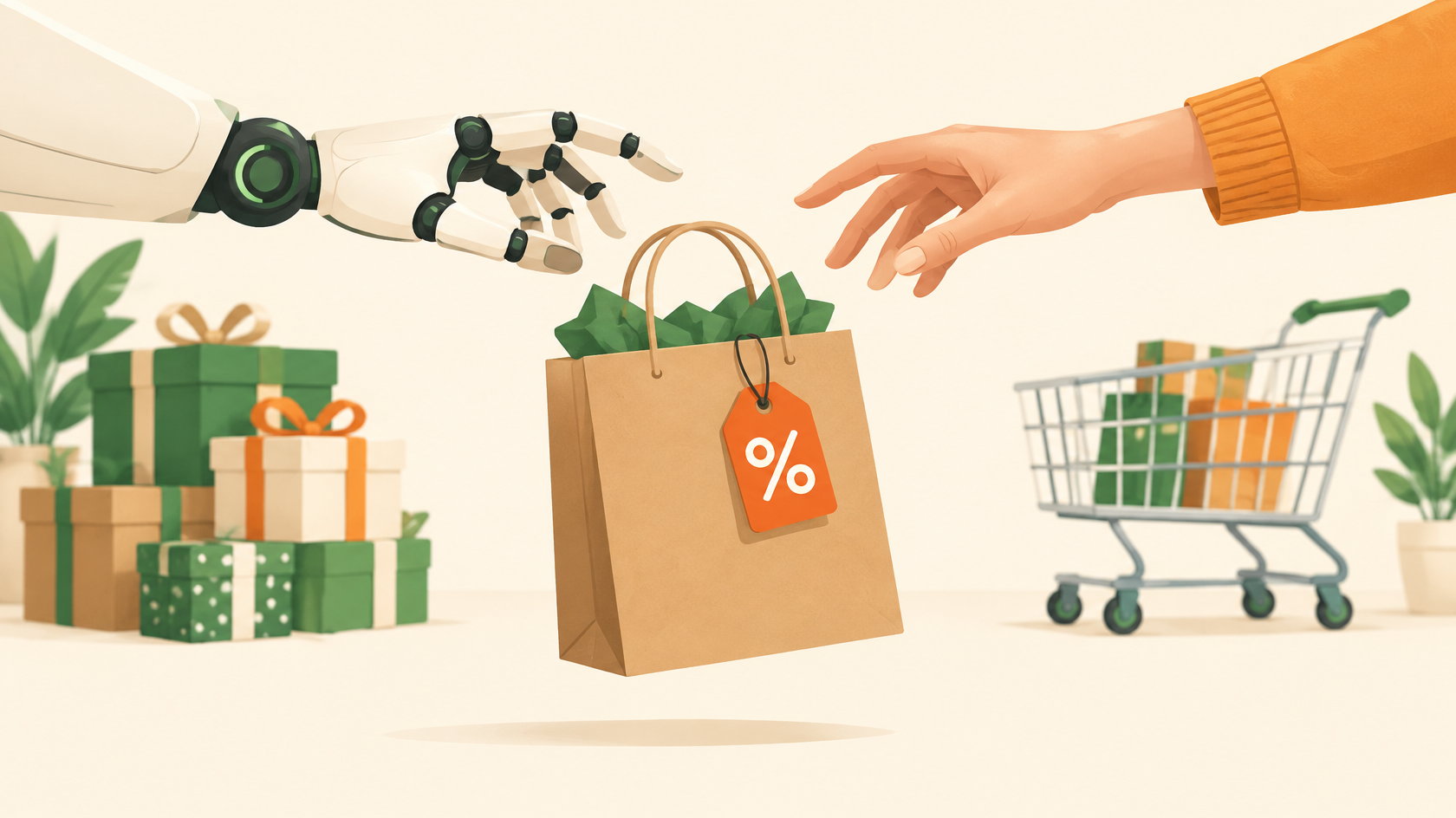
Black Friday 2026 and AI agents: what changes when we shop
Black Friday 2026 is the first one where AI agents can search, compare, and even pay on our behalf. In Italy, where I live, the sales season now stretches across almost two weeks: according to Netcomm estimates reported by Affaritaliani, it runs from Thursday, November 19 to Tuesday, December 1, with around €4.3 billion spent online during Black Week alone, 6% more than in 2025.
I take part, but with a grain of salt. Every year I get the feeling that certain prices creep up in the weeks before, just in time to show off generous discount percentages that, on closer inspection, turn out to be fictitious or negligible. And running every check by hand, product after product, price history after price history, is mind-numbingly dull. So I started wondering: what if an agent did this job for me?
The suspicion of prices inflated before the sales
I’m not the only skeptic. Altroconsumo, Italy’s largest consumer association, found in its Black Friday 2025 survey that more than half of Italians believe some stores raise their prices in the preceding weeks to make the promotions look artificially appealing. The same study noted that a growing share of shoppers now track prices over time precisely to protect themselves from fake markdowns.
Across the Channel, the numbers are even harsher. Which?, the British consumer group, has been analyzing deals from major electronics and appliance retailers for years: in its latest review, nine “bargains” out of ten were available at the same price, or lower, at other times of the year. Black Friday, in short, rarely turns out to be the cheapest day to buy.
The 30-day rule and its loopholes
In Europe, there is a safeguard. The Omnibus Directive, which Italy wrote into Article 17-bis of its Consumer Code, requires anyone advertising a discount to show the lowest price charged in the previous 30 days. In theory, a quick glance should be enough to tell whether that promised 40% off is real.
In practice, the rule leaves a few gaps. A price hike applied well in advance, say in early October, falls outside the reference window and becomes the new baseline. On top of that, the comparison only covers a single seller: nobody tells us whether the same item was cheaper elsewhere for months. Finding out takes comparison sites, price trackers, and wish lists with alert thresholds. All of them valuable and, let’s admit it, exhausting.
AI shopping agents: from search to payment
This is where agents come in. Visa launched Intelligent Commerce back in April 2025, the infrastructure that lets AI assistants complete transactions on its network, and Mastercard answered with Agent Pay. In June 2026, Visa announced a partnership with OpenAI on agent-led payments, with limits users can set themselves: how much to spend, at which merchants, and when a human approval is required before going ahead.
Industry forecasts are enthusiastic. Adobe expects AI-referred traffic to US e-commerce sites to grow 95% year over year on Black Friday itself. In Italy, according to YouGov, almost four people in ten plan to shop between Black Friday and Cyber Monday, and 39% of them have already turned to AI for help with a purchase. The same research firm, however, observes that Italians use these tools to hunt for deals, not yet to place the order.
Why the agentic shopping frenzy hasn’t arrived yet
Not everyone shares the optimism. Diginomica stated bluntly that this holiday season won’t bring any agentic AI shopping frenzy. An Omni Calculator survey of nearly 900 Americans tells the same story: 59% plan to use AI during Black Friday, yet only 7% will start their search with a chatbot, while most still begin on Amazon or Google.
The platforms are treading carefully too. OpenAI, which had bet on checkout directly inside ChatGPT, scaled the project back in March 2026, moving purchases into individual merchants’ apps. And in its own report on agentic commerce, Visa places the current phase at the stage where AI initiates the payment, but with the user’s active confirmation on every transaction. Full autonomy, for now, is reserved for low-risk purchases within very tight guardrails.
My deal with the agent: research for it, cart for me
I would gladly hire an agent. I’d hand it the grunt work: rebuilding price histories, unmasking markdowns calculated on padded list prices, comparing shipping and return policies, weeding out websites born two weeks ago that will vanish by December. For someone who hates the detective side of shopping, it would be a huge relief.
Before I click Buy, though, I want to see what’s in my cart. There’s always that inexplicable preference, that last-minute inspiration, that over-the-top impulse that changes the choice. Maybe the agent found the cheapest blender on the web, and at the last second I decide the sage green one, six euros more, looks better in my kitchen. No algorithm can predict a whim like that, and frankly I wouldn’t want one to.
Trust and control, two design questions
From a UX perspective, the real challenge for shopping agents lies in that final moment. A checkout that disappears entirely takes away the user’s last chance to reconsider, double-check sizes and quantities, or catch a mistake. A clear summary before payment, on the other hand, becomes the point where trust is built or cracks.
I’ve already written about dark patterns that now cost companies dearly: fake countdowns, invented scarcity, and hidden subscriptions are the same tricks that multiply at the end of November. A good agent should be able to spot them and ignore them. And there’s still the question of trust in payments, which I touched on when I asked whether WhatsApp Pay is too late: handing your card and data to a new intermediary is never a trivial step, let alone to software acting on its own.
Shopping with AI without losing the final say
The most sensible path, at least this year, seems to be the middle one. AI as a tireless bloodhound that sniffs out genuine discounts and discards the cosmetic ones, and us as the final judges who approve, correct, or change our minds. It’s the same balance I looked for when I let AI pick my sofa: extremely useful for exploring, less convincing when it comes to personal taste.
Agents will get smarter, payment protocols safer, and a few Black Fridays from now delegating the whole order will probably feel natural. Until then, I’m holding on to my cart.
Related sources
- Black Friday 2025: italiani pronti a spendere di più, ma resta lo scetticismo sugli sconti, Altroconsumo (in Italian)
- Black Friday 2026, altro che crisi: gli italiani sono pronti a spendere. Ecco tutti i numeri, Affaritaliani (in Italian)
- Il ruolo dell’IA durante il Black Friday e il Cyber Monday 2026, YouGov (in Italian)
- Nine in 10 Black Friday ‘deals’ cheaper or same price at other times of year, Which?
- Recepimento in Italia della direttiva Omnibus: il decreto legislativo 26/2023 in pillole, Osborne Clarke (in Italian)
- How will agentic commerce shape Black Friday 2026?, CX Network
- Agentic reality check: no, it’s really not going to be an agentic AI shopping frenzy this Holidays season, diginomica
- 59% of shoppers plan to use AI this Black Friday, but just 7% will start their search there, Omni Calculator
- Visa and OpenAI team up on agent-led payments, Digital Commerce 360
- The rise of Agentic Commerce, Visa Consulting & Analytics
