
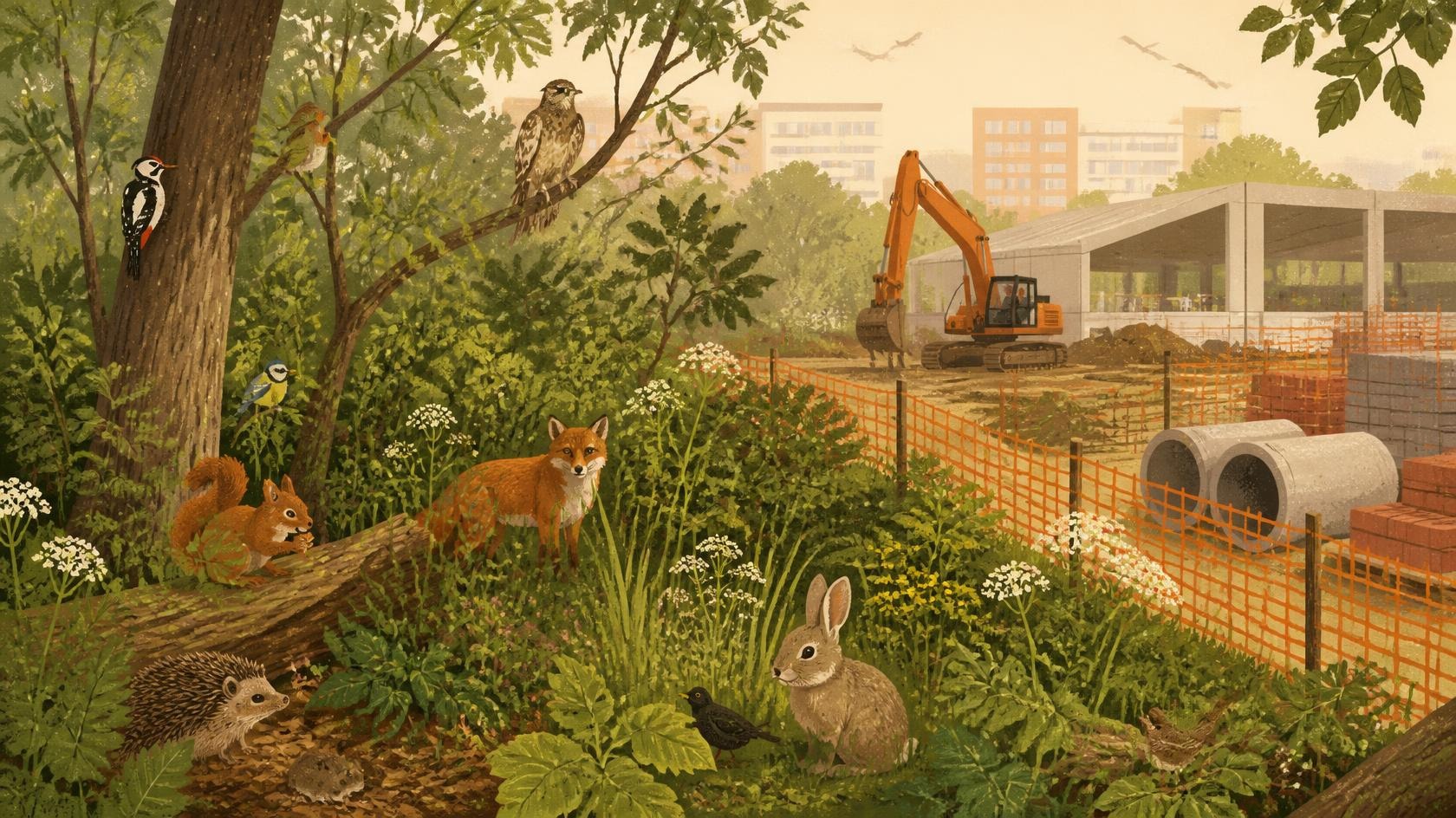
Bosco Ospizio in Reggio Emilia: a self-grown woodland cleared for a new Conad
Bosco Ospizio, in the Italian city of Reggio Emilia, is a green area of about 45,000 square meters that grew on its own. Nobody ever planted it as part of a plan. Since August it has been at the heart of an environmental and legal battle, because Conad Centro Nord, one of the cooperatives behind Conad, Italy’s largest grocery chain, has opened a building site there for a new supermarket. On September 30, police and bulldozers cleared the residents’ sit-in, and by evening almost all the vegetation was on the ground. Eight days later, the Council of State, Italy’s top administrative court, suspended the felling of the remaining trees.
I still hope the two sides can reach an agreement. That said, it is sad to watch a spontaneous ecosystem disappear to make room for concrete and parking lots.
From nursing home to urban woodland: the history of the site
Where the construction machines now stand, there used to be a nursing home, later demolished. The neighborhood takes its name from that old hospice, “ospizio” in Italian. After the demolition, nature reclaimed the land: years of neglect produced a thick tangle of trees, shrubs and grasses. The city describes it as a private plot, “degraded and inaccessible.” For the neighborhood, it was a pair of lungs.
Conad Centro Nord bought the lot many years ago. According to the newspaper Il Resto del Carlino, it has held building rights since 2006. In 2015 the city signed an agreement with the cooperative. The implementation plan, however, was filed too late, and the city declared the right to build expired. That started a long legal tug of war:
- in 2022 the regional administrative court (TAR) in Parma partly sided with the developers;
- in 2024 the Council of State upheld the building rights for good;
- in 2025 the city signed the development agreement;
- in February 2026 the building permits were issued.
The project: supermarket, public services and offsets
The project is about more than the supermarket. Alongside the store, the same building is set to host a neighborhood library, a social services hub and a community health center. Conad is also responsible for the infrastructure work: roads, sidewalks, parking, an entrance roundabout and about 23,000 square meters of green space to be handed over for public use, with community gardens and a playground. Compared with the original design, the built volume has dropped from 20,000 to 12,000 cubic meters. The city expects around forty new jobs.
On trees, the figures don’t match. According to deputy mayor Lanfranco De Franco, the site will go from its current 322 trees to more than 1,500 new plantings. The anti-vivisection league LEAL instead speaks of 98 trees cut down and 370 planted. Experts heard by the city council argued that the offsets were miscalculated. One figure stands, though: according to the Salviamo il Paesaggio network, between buildings, parking and roads, almost 70% of the area will be sealed.
The animals and plants that lived in the woodland
An arborist and a group of botanists carried out independent surveys and counted 168 plant species. Among them is a cherry plum (Prunus cerasifera) with a trunk circumference of 255 centimeters: above the regional threshold for a monumental tree.
The wildlife was just as varied. Animal welfare groups list:
- the European green toad, an amphibian protected under the EU Habitats Directive;
- hedgehogs and small rodents;
- bats;
- urban and woodland birds that nested there;
- moths, wild bees and dragonflies.
The city points out that the Rifugio Matildico wildlife shelter has already relocated seven hedgehogs. But a toad doesn’t move house that easily, and a pollinating insect won’t follow the rescue van.
The independent ecosystem assessment adds figures that are less visible but very real. Every year the woodland held back almost 92 cubic meters of stormwater runoff, and it had stored 9.63 tons of carbon. All this in a neighborhood that the city itself rates as extremely vulnerable to heat. The study commissioned for the project claims instead that more than two-thirds of the plants were in decline and potentially dangerous. The authors of the independent assessment dispute that.
Sit-in, lawsuit and eviction: what happened in August and September
Residents organized as early as 2024, forming the Permanent Assembly of Bosco Ospizio. That summer, nearly 2,400 signatures secured an open city council session, only the second in the city’s history. The online petition, according to LEAL, later passed 62,000 supporters.
On August 3, 2026, the sit-in became permanent. Conad Centro Nord filed a criminal complaint against persons unknown for private coercion and trespassing, and asked the prefecture to break up or relocate the protest. On August 29 the city brought activists and the cooperative together, with no result. The eviction came on September 30, with riot police on site and a few young people taken to the police station.
Meanwhile the protest spread. People started campaigns to hand back their loyalty cards and “shopping without Conad” initiatives as far away as Rimini, while Extinction Rebellion put up “Boycott Conad” posters outside the chain’s national headquarters in Bologna.
Court appeals: where things stand
The legal front is still open. In July the TAR in Parma rejected the request for an injunction filed by residents and Legambiente, with the backing of WWF. The case on the merits, however, is still pending. The animal protection group LNDC joined in support of the appellants, arguing that the project never went through the required environmental impact screening. A complaint has also been filed with the public prosecutor’s office over the environmental assessments.
The turning point came on October 8. In an interim order, the Council of State suspended the measures “limited to the felling of further trees.” It also asked for a prompt review and sent the case back to the TAR so it can schedule the hearing on the merits as a priority. It comes too late for most of the woodland, but it saves what is still standing.
Does the Ospizio neighborhood really need another supermarket?
The underlying question is about real need. I looked at the available data.
Supermarkets nearby. Back in 2023, the local party Reggio Emilia in Comune was already calling it the fourth retail facility within a few kilometers. It named some of them: the Quinzio shopping center, the Coop on via Sani, the Eurospin discount store. Close by there are also a Conad on via Leonardo da Vinci, plus a Despar and a Pam Local on via Emilia a San Pietro. For anyone living in that part of town, none of these stores is far away.
Retail density in the region. The regional retail observatory measures the sales floor area of modern grocery retail. In 2022 Emilia-Romagna had 283 square meters for every thousand residents, against 268 for the Italian average and 286 for Spain.
| Indicator (Emilia-Romagna) | From 2007 to 2022 |
|---|---|
| Sales floor area | +25.8% |
| Number of stores | -14.1% |
The data shows fewer but larger stores: the growth comes from superstores and discount chains, which is exactly the format planned for Ospizio.
Land take. According to the 2025 report by ISPRA, Italy’s environmental protection agency, in 2024 Emilia-Romagna was the Italian region that turned the most new land into artificial surfaces, with 1,013 hectares. It also ranks first for land taken by logistics. The most intense changes are concentrated along the via Emilia, the very road Bosco Ospizio faces.
The picture isn’t entirely one-sided. The library, the social services hub and the health center meet real needs in the neighborhood, and Conad is acting within rights the courts have recognized. But the public services could have found a home elsewhere. The need for yet another shelf of pasta and detergent, a few hundred meters from the ones already there, is much harder to prove.
As for me, I prefer to shop from local producers at Campagna Amica, as I wrote in Greener groceries, three ways. That’s why a new superstore ringed by parking spaces looks to me like yesterday’s answer to a question that has since changed.
The compromise proposals still on the table
Alternatives exist, and they have been put in writing. In August the Bosco Assembly proposed:
- Shared management: running the area jointly with the city, the University of Modena and Reggio Emilia, and local associations.
- Land swap: a 90-day negotiation to move the building rights to an already developed plot in the eastern part of the city.
- Purchase: alternatively, the city buying the lot.
- Services at San Lazzaro: moving the public services into the buildings of the former San Lazzaro psychiatric hospital.
- Regional funding: tapping a €2 million regional grant for ecosystem services.
There is also a precedent: in July 2024 the same city saved the green area on via Piaggia, near Quinzio.
The halt to the felling and the upcoming hearing at the TAR open a window of time. Twelve researchers from the universities of Bologna and Parma have asked for the works to be suspended. The city’s environment councillor, Roberto Neulichedl, said that “a step back” by Conad “would be nice.” A cooperative that funds campaigns like “Riforestiamo l’Italia” (Let’s reforest Italy) has a chance to prove it on its own doorstep.
Readers who share this worry may want to read my piece on eco-anxiety: every hectare that disappears in the region that paved over more new land than any other in Italy in 2024 weighs a little more.
Related sources
- Reggio Emilia, il bosco deve diventare un Conad: polizia e ruspe sgomberano la protesta, L’Indipendente
- A Reggio Emilia stanno sradicando un bosco di 4,5 ettari per fare spazio all’ennesimo ipermercato, Fanpage
- Reggio Emilia, Conad querela gli attivisti in presidio per il Bosco Ospizio, Il Fatto Quotidiano
- Pru Ospizio, concessi i titoli edilizi: “Via ai lavori non prima di luglio”, Il Resto del Carlino
- Bosco Ospizio: “Non è detta l’ultima parola”, Il Resto del Carlino
- Reggio Emilia: storia di un bosco che diventa storia di una comunità, Salviamo il Paesaggio
- Reggio Emilia, a Ospizio un altro Conad della “discordia”, Stampa Reggiana
- Bosco Ospizio, il Consiglio di Stato accoglie la richiesta di sospensiva, LNDC Animal Protection
- Bosco Ospizio – Reggio Emilia: un polmone distrutto per un supermercato, LEAL
- Confronti della distribuzione grocery in Emilia-Romagna con altre regioni e nazioni europee (2024), Emilia-Romagna regional retail observatory
- Sintesi del Rapporto Consumo di suolo – Edizione 2025, ISPRA/SNPA
