
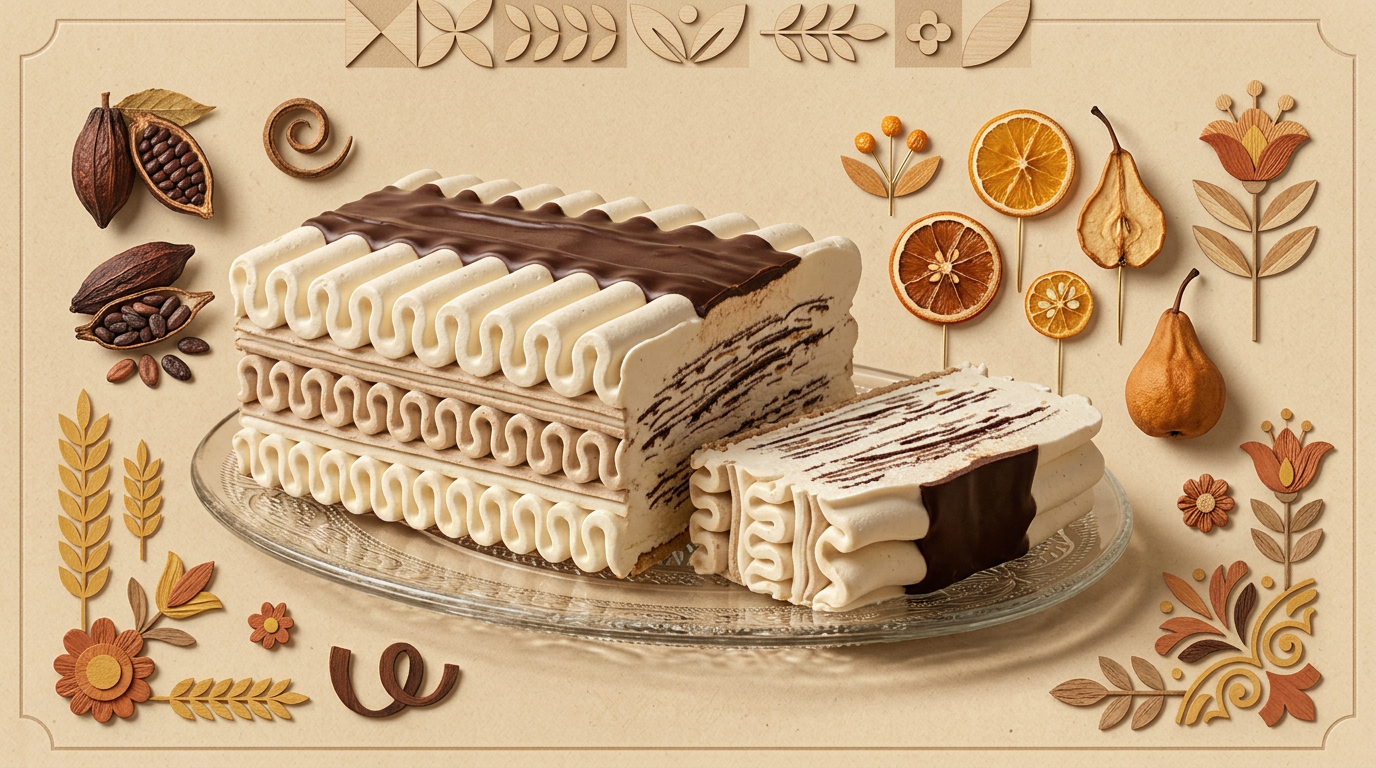
My grandmother bought it for the holidays, pulled out of the freezer like a special treat for the table, not some ordinary scoop grabbed at a bar. Years later, at university, Viennetta had become the Saturday night ritual with my roommates: we sliced it before heading out, almost a sweet prelude to the evening. Today I still look for the Fantasia di Biscotto variant I loved so much, and I can no longer find it anywhere, replaced by newer flavors. But that layered cake of whipped cream and crunchy chocolate did far more than accompany a generation’s Saturday nights: it helped change ice cream habits across Italy.
How Viennetta ended ice cream’s seasonality
Until the Eighties, ice cream stayed confined to summer: eaten at the seaside, on day trips, on warm evenings, and it vanished from people’s cravings as soon as the cold arrived. Viennetta flipped this logic, positioning itself from launch as an alternative to panettone on the Christmas table. A marketing move as simple as it was effective, one that paved the way for every freezer product designed for the winter months, from festive semifreddos to ice cream cakes for off-season birthdays.
Who invented Viennetta, and why at Christmas
The idea carries the signature of Kevin Hillman, product development manager at Wall’s, the British arm of Algida. The project began in 1981 and reached shops the following year, designed on purpose as a Christmas specialty rather than a summer indulgence. Its layered structure, soft cream alternated with thin shards of dark chocolate, was quite a technical novelty for the time, and it remains the product’s defining trait today.
Algida, for its part, started as an artisan gelateria in Rome in 1946 and came under Unilever’s control in 1964, becoming part of a multinational group. Viennetta, meanwhile, has traveled the world in different flavors, from tiramisu to crème brûlée, not all of which made it to Italy. In the United States it disappeared from supermarket shelves for three decades, only to return in 2021 riding the wave of nostalgia that now drives much of food marketing, the same phenomenon described in Vintage labels and identity.
Ice cream in Italy: artisan versus packaged
The artisan sector is worth over 3 billion euros a year, with more than 600 million servings sold and growth estimated around 6% in 2026, driven by tourism and a search for quality. Each Italian consumed roughly 2.8 kilograms in 2021, with prices ranging between 20 and 28 euros per kilogram (over 30 in tourist destinations) and an average cone costing between 3 and 4 euros, climbing past 5 in holiday resorts. Between 2002 and 2026, prices rose by 138%, with a 9% jump alone between 2024 and 2025.
Packaged ice cream tells a parallel story: in 2025 production hit 261 thousand tons valued at 3 billion euros, with exports of 116 thousand tons and 468 million euros, 64% of it bound for the rest of Europe. Per capita consumption is close to 3 kilograms a year, the domestic market is worth 1.5 billion euros, and the first months of 2026 posted +9% in volume and +10.7% in value. Pistachio and mango lead consumer preferences, plant-based alternatives are growing by 3.7%, nearly 70% of the milk used is Italian, and 98.5% of the cocoa comes from certified supply chains. Anyone curious to dig deeper can also read Summer and the Ferrero ice-creams.
How much ice cream Europe eats
In 2023 the European Union produced 3.2 billion liters of ice cream, down 1.4% from the previous year. On the podium of producers sit Germany (612 million liters), France (568 million) and Italy (527 million), confirming its place among the continent’s top three by volume. Exports to non-EU countries are worth 1.04 billion euros, up 5%, while imports fell by 8%. Prices vary widely from one market to another: starting at 1.8 euros per liter in Germany and climbing to 7.7 euros in Austria.
As for per capita consumption, the European ranking is surprising: Poland tops it with roughly 16 kilograms a year, followed by Sweden (10.87 kilograms) and Spain (9.65 kilograms). Italy ranks only seventh, while Germany sits around 8 liters per capita, for a national total of 540.8 million liters in 2024. A figure that catches off guard anyone who pictures Italy as the undisputed homeland of ice cream: we are, by tradition and production, far less by the amount eaten per person.
Why nostalgia still outsells novelty
Viennetta’s comeback on American shelves in 2021 is no isolated case. It belongs to a broader trend, one where brands revive old recipes and packaging to reach people seeking comfort in a memory, a shift also captured well in Nonna maxxing and Gen Z. I still haven’t found my Fantasia di Biscotto again, but I keep looking every time I pass the freezer aisle. Maybe that’s the whole point: ice cream, today just as in the Eighties, stays tied more to moments than to the thermometer, which is why it no longer takes a break once summer ends.
Related sources
- Se oggi mangiamo gelato tutto l’anno il merito è anche di questo mitico semifreddo Anni ’80, CiboToday
- Chi ha inventato la Viennetta Algida? Ve lo raccontiamo noi, Gambero Rosso
- EU ice cream production fell by 1.4% in 2023, Eurostat
- Numeri, preferenze e sostenibilità: il gelato confezionato verso l’estate 2026, Fornelli d’Italia
- Gelato artigianale: in Italia consumo pro capite 2,8 kg, Gelato News
- Gelato in Europa: quali sono i gusti più richiesti e dove se ne mangia di più?, Euronews
