
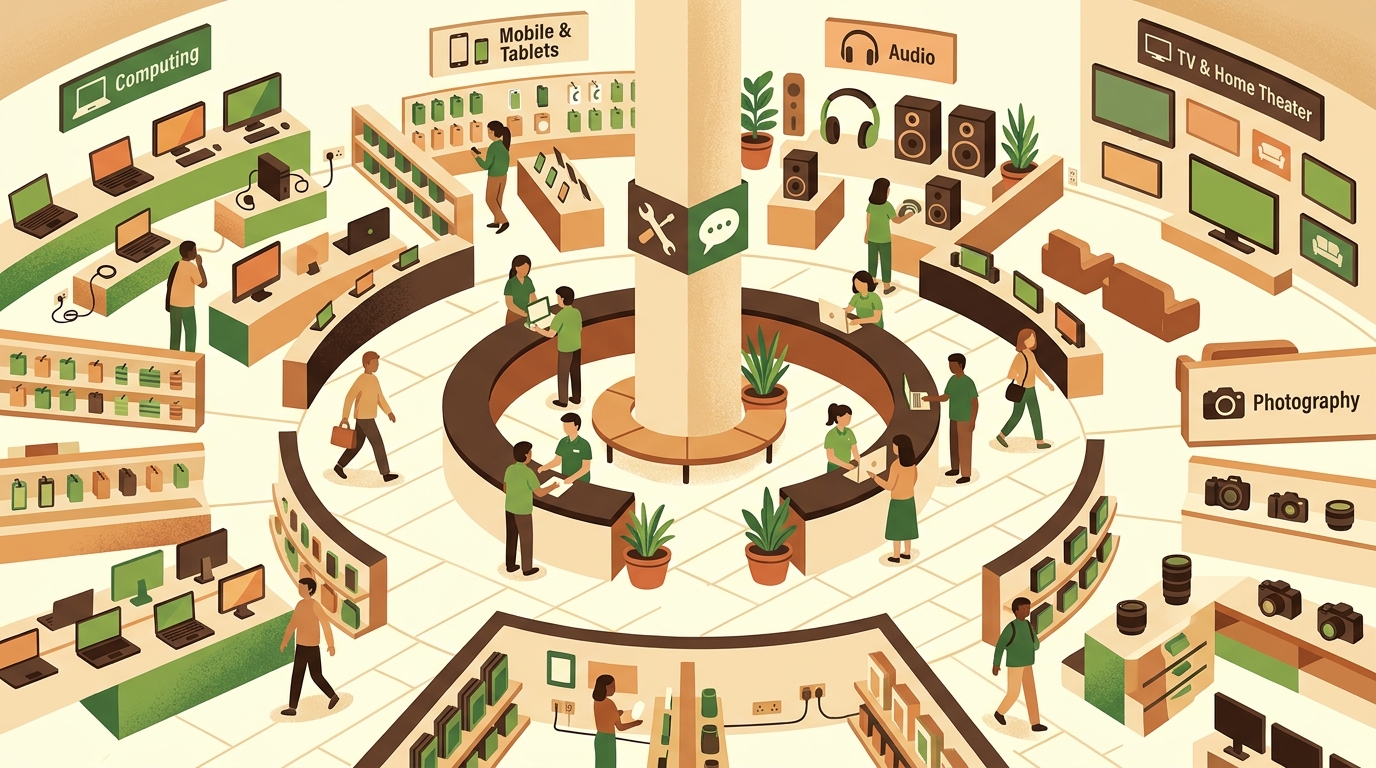
Unieuro’s new retail format starts from a central hub
On September 17, 2026, Unieuro opened the first store in its network redesigned along new lines, in Lissone, north of Milan. At the heart of the floor sits a Client Hub of roughly 85 square meters, gathering reception, Click & Collect, after-sales support, repairs, installations, financial solutions and energy offers. The departments fan out all around it, with signage meant to be read from a distance. Country manager Bruna Olivieri described an evolution in which products, services, advice and technology come together naturally. Chief retail officer Luigi Fusco called Lissone a laboratory for the whole chain: performance will set the pace at which the concept reaches the other locations.
How often we end up circling, looking for someone to answer
Anyone who has crossed a big-box electronics or DIY store recognizes the scene. The right item sits on the shelf, the tag with availability is missing, no associate covers the aisle, and the person at the nearby counter points toward another zone, which in turn sends everyone back to the registers. Meanwhile the afternoon disappears.
I rarely end up in those warehouses myself, since almost all of them sit outside town and my Citroën Ami is the wrong vehicle for the trip: someone else has to take the wheel. Which is exactly why, once I get there, the errand has to close within those two hours.
The pattern has an explanation beyond the anecdote. As a retail consultant put it in a Confcommercio publication, a sales floor gets traveled like a route rather than explored like a park. In his example, a shop showed generous traffic and remarkably long dwell times alongside mediocre conversion: people lingered because they had lost their bearings.
Off the shelves, the same trouble is called information scent
In digital design this has a precise name, information scent, meaning how well someone can predict where a given path leads. Nielsen Norman Group documented the worst case, the strong yet misleading cue: shoppers looking for child car seats in an ecommerce site’s automotive section concluded, on not finding them there, that the retailer did not carry them. They sat elsewhere, with no cross-reference.
The abandonment numbers are substantial. Harris Poll research commissioned by Google Cloud, covering nearly 13,500 adults across fourteen countries, put the global value of sales lost to failed searches above two trillion dollars a year, with 53% of consumers walking away from the cart after a fruitless attempt. On the physical side, a survey reported by Retail Dive recorded 39% of people giving up on an in-store purchase in front of an empty shelf. The mechanism matches: once the cue goes missing, the errand stops.
A counter in the middle works like persistent navigation
Here the parallel with UX design becomes powerful. Well-built interfaces always keep one element reachable from every screen: the logo that leads home, the fixed bar, the breadcrumb trail. Its job is to make mistakes cheap. Taking a wrong turn costs little when the way back stays visible.
A Client Hub planted in the middle of the floor plan performs that duty in physical space. From any department, there is one place where somebody answers, where the parcel ordered online waits, and where the broken television gets logged in. Merging reception and assistance removes the bouncing from desk to desk, what the web would call pogosticking, and turns the hunt for an associate into a single direction.
Miro fills the gaps the signage leaves open
The store runs without paper: product sheets open through a QR code, prices live on electronic labels, staff carry mobile devices, and information flows across roughly 150 screens, from the LED wall at the entrance to the departmental displays. Above all that runs Miro, a conversational assistant reachable from a smartphone, which interprets spoken and written requests and suggests items actually held in stock. Luigi Pontillo, Unieuro’s CIO, explained that it aims to catch shoppers comparing prices on their phones by offering immediate alternatives. The underlying technology is Google Cloud’s Gemini Enterprise, in what the company presents as the first European application of its kind in retail.
On this point I stay cautious. An assistant like that is worth exactly as much as the data beneath it: knowing the real inventory of that single location makes it the tag that never appears on the shelf, while parroting the catalog only adds another layer to the visit. Personalization for its own sake has already proven tiring. The more convincing signal comes from headcount, up 10% in Lissone: advice on the floor remains a human craft, and support still defines the brand far more than the sign above the door.
Paying wherever you stand removes the last friction
The other classic obstacle is closing the purchase. The format offers traditional registers, self-service stations and mobile card readers in the hands of departmental staff, so payment happens at the precise spot where the decision ripened. In digital products this is the most studied lesson of them all: every extra step between choice and confirmation erodes a share of conversion. Removing the line removes the moment when somebody glances around and changes their mind.
What will tell us whether the model worked
A central hub carries an obvious risk, that of pulling everything toward itself and leaving the aisles unstaffed, becoming a bottleneck on December Saturdays. The concept will be judged there, on its ability to stay a reference point without turning into one long queue. The displays deserve equal care: the distance between retail media and orientation is thin, and 150 screens can guide or simply add noise right where a shopper’s head is already working at full tilt.
The principle holds regardless, on 1,500 square meters as on a six-inch screen. Putting someone at the center means one thing only: making the road toward whatever brought them there short and predictable. When it succeeds, the work goes unnoticed, and that is the finest compliment it can receive.
Related sources
- Unieuro cambia lo store fisico: a Lissone il nuovo format che mette il cliente al centro, letteralmente, DDay.it
- Unieuro, a Lissone debutta il nuovo format con il maxi Hub centrale, retail&food
- Unieuro riparte da Lissone: il nuovo format retail guarda al futuro, MBNews
- Unieuro e Google Cloud a Lissone: il nuovo format retail, Tech Business
- Unieuro accelera sul retail media con il nuovo format di negozi, Brand News
- Deceivingly Strong Information Scent Costs Sales, Nielsen Norman Group
- New research on search abandonment in retail, Google Cloud and Harris Poll
- Survey: 39% of consumers have ditched in-store purchases due to out-of-stocks, Retail Dive
- Il cliente non esplora, attraversa: come guidarlo in negozio, Confcommercio Savona
