
Dyson CameraJet, the electric toothbrush with a camera and AI pulled from stores
On September 1, in Paris, a short walk from where the Bastille once stood, James Dyson unveiled CameraJet, the brand’s first electric toothbrush, calling it “a small revolution.” It costs about $500 (480 euros in Italy) and packs a tiny camera next to the brush head, linked to an artificial intelligence system that recognizes the gaps between teeth and fires a jet of water into them, the way a water flosser would. Two weeks later it could no longer be bought in several countries, Italy included, while reports of failures and battered gums kept piling up online.
Let me say it right away: I’m a devoted Dyson fan. At home I have vacuum cleaners, hair dryers and air purifiers designed by the British inventor, and my old Braun, after many years of faithful service, is about to give up the ghost. On paper I’d be the ideal customer. Yet faced with this little gadget I decided to take my time, and the news of the past few weeks is proving me right.
What went wrong: water in the battery, overheating and jets that hit too hard
According to accounts gathered by Cybernews and Smart Home Assistant, buyers in the UK, the US and France have complained of water seeping into the battery compartment, overheating while charging, oxidized internal parts and devices that stop responding after a few uses. On Reddit and social media, some people have also described minor injuries: when it accidentally hits a tooth instead of the gap, the jet seems to pack quite a punch.
The company has admitted that “a small number of early batches” may have had a component issue, and it has offered to replace or refund the affected units. In the same statement, though, it blamed the empty shelves on strong demand and on production still being scaled up: two explanations that sit awkwardly together, as several observers have pointed out.
Camera, AI and a dedicated toothpaste: CameraJet’s chain of dependencies
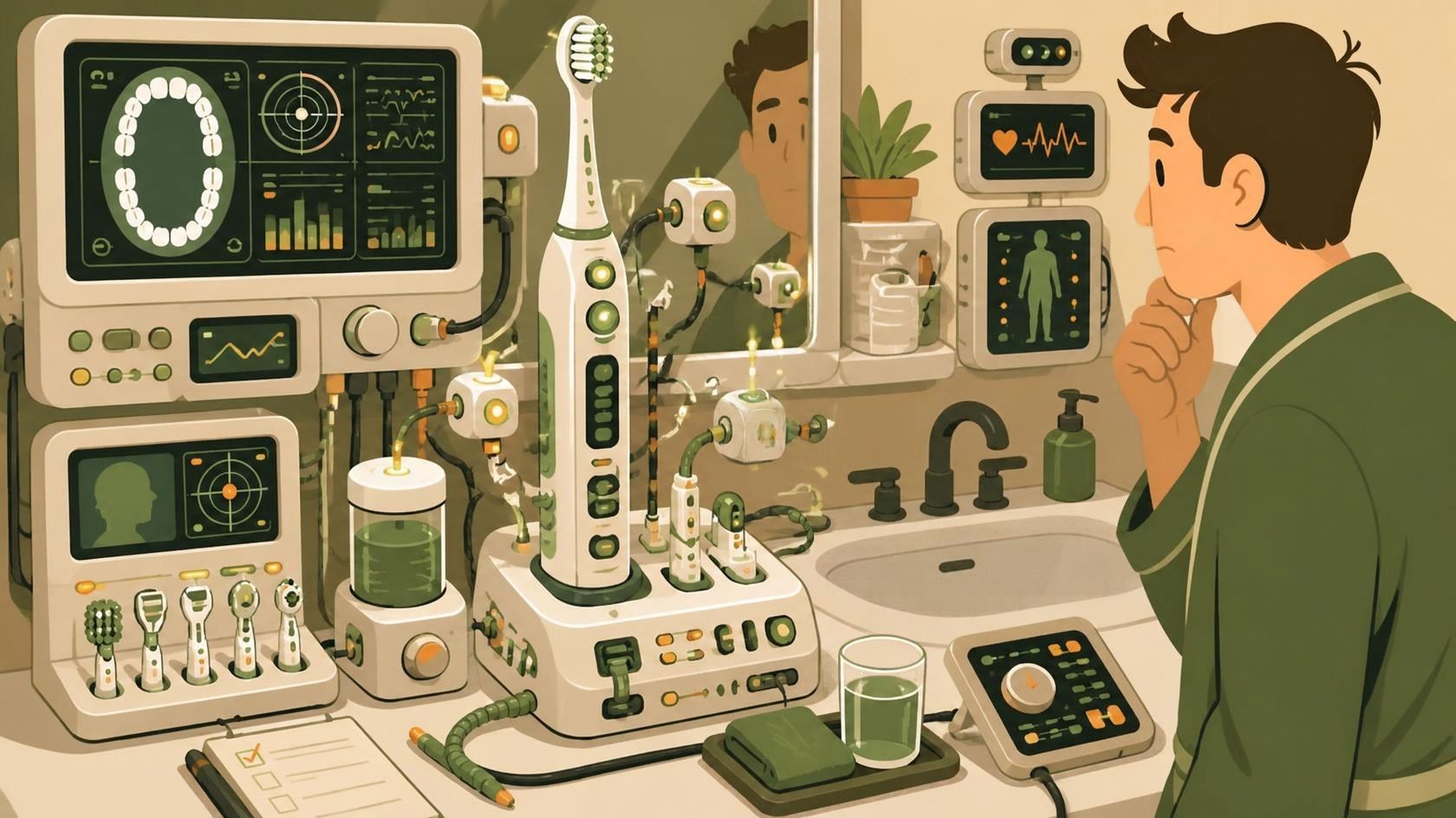
For anyone working in user experience, the most instructive part lies in the design. To aim the water at the right spot, the toothbrush has to “see” the teeth. Seeing them requires a lens with a small light source, and telling a gap from a molar requires an AI model that maps the mouth. That’s where the first snag appears: the foam from regular toothpaste blinds the sensor. Dyson’s fix is a proprietary “non-foaming” paste at 10 euros for 75 ml, roughly five times the price of budget brands, plus a dedicated mouthwash to pour into the charging base.
Each added element needs another one to work, and each brings a new weak spot. Il Post reports that the failures seem to cluster in the reservoir, the part that handles the liquid. One Reddit user has also posted a list of fixes for the most common problems: condensation forming between the lens and its casing, a brush head that has to stay pressed against the teeth at exactly the right angle, and liquid building up in the mouth that forces users to lean over the sink several times during the two-minute cycle.
Overengineering and feature creep: when features get in the way
Design jargon has a name for this: overengineering. UXPin describes it as adding needless complexity instead of focusing on what people actually need, and lists sheer technological enthusiasm among its causes. Its example could have been written for CameraJet: a toaster with Wi-Fi, voice commands and a dozen settings, when nearly everyone just wants evenly browned bread.
Marketing research flags the same risk. A study by Wayne Hoyer (McCombs School of Business, University of Texas at Austin) with Andreas Fürst and Nina Pecornik, carried out on 1,300 people, shows that adding features makes a product seem more capable but also harder to use. And when those capabilities are heterogeneous, meaning loosely related to one another, even trust in the promised performance drops. Brushing, irrigating, filming and computing: it’s hard to imagine a more mismatched set packed into a single handle.
Why brushing your teeth should stay quick and effortless
Brushing is one of those actions repeated several times a day, often half asleep or in a rush. It’s the territory where good UX works by subtraction: fewer decisions, fewer steps, fewer chances to slip up. Even minimal friction, multiplied by two or three times a day all year long, ends up weighing on people. That’s exactly why I’m waiting: I don’t want an automatic habit to become a procedure that demands attention, with the head tilted just so and the right tube within reach.
People who have tried CameraJet report a satisfying clean, and I have no reason to doubt them. What remains is the cost in attention, on top of the cost in dollars. I feel the same about smart glasses: the technology looks promising, but before adopting it I want it to fade into the background, a bit like the interfaces that have embraced the design of silence.
The paradox of a brand built on simplification
Finally, there’s a question of identity. Dyson became famous by removing something: the vacuum cleaner bag. Its founder spent years developing that model and proved that many people were willing to pay more for an appliance that took away an annoyance. Today bagless technology is the standard, imitated everywhere.
CameraJet heads the opposite way: it piles components, dedicated consumables and instructions onto a tool that, used properly, has done its job for centuries, alongside dental floss, which costs a few dollars and never asks for updates. For a fan like me it’s a small betrayal, and at the same time a useful lesson for anyone designing products, physical or digital: AI makes sense when it lightens the load for the people using it, and if it merely shifts the effort elsewhere, it has missed the mark.
Related sources
- L’avveniristico spazzolino di Dyson fa acqua, Il Post
- Dyson $500 AI CameraJet toothbrush users report overheating, charging problems, Cybernews
- Dyson CameraJet Toothbrush Pulled From Sale Over Fault Reports, Smart Home Assistant
- Marketers Can Manage “Feature Creep”, McCombs School of Business
- Overengineering: What is it and How Design Can Help?, UXPin
