
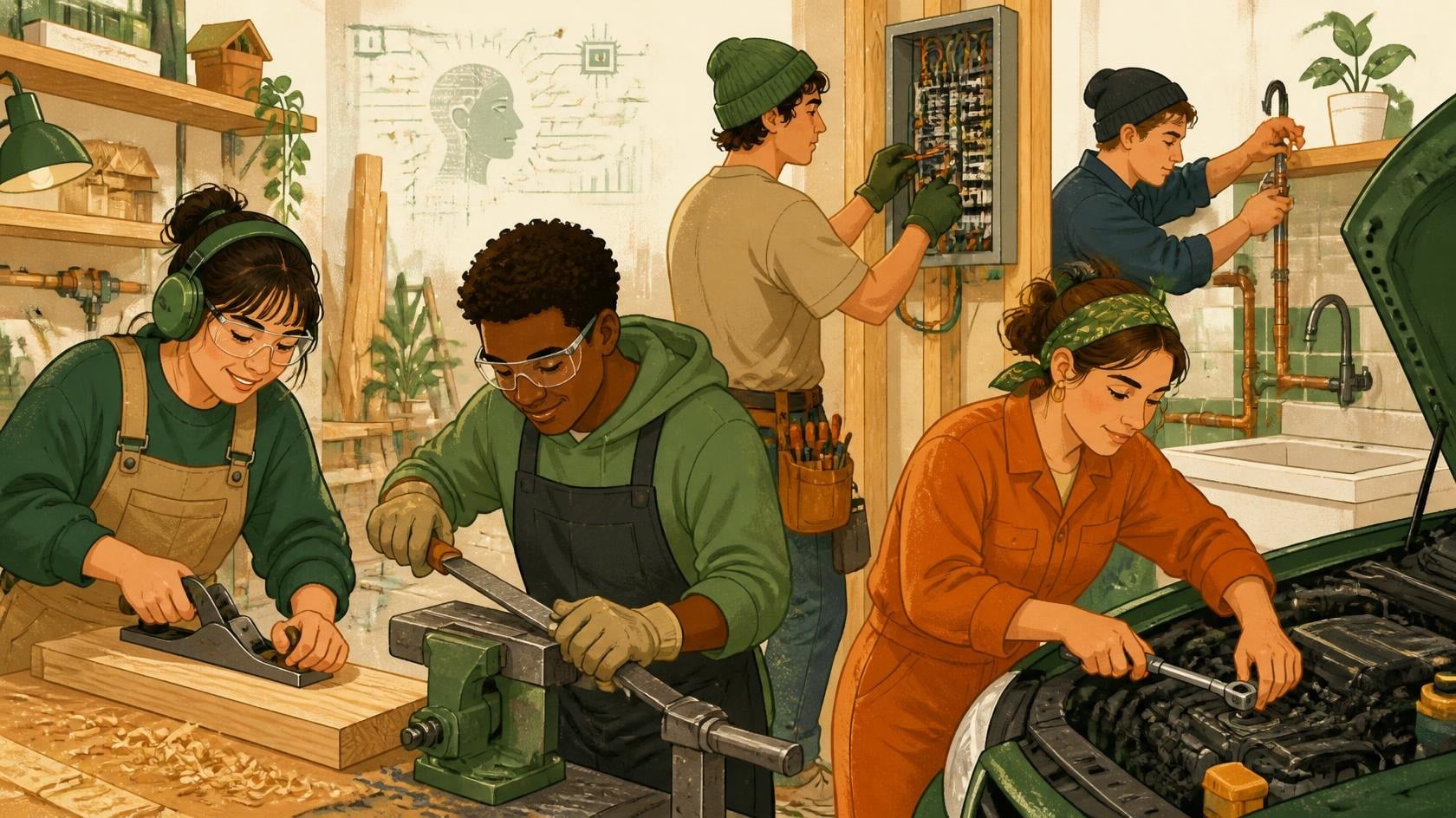
Toolbelt Generation: why Gen Z is going back to manual work
“Toolbelt Generation” is the nickname given in the United States to Gen Z kids who skip the office track and sign up for plumbing, welding, carpentry, and electrical programs. The Italian magazine Panorama covered it recently, and the piece landed at just the right moment, because in our home high school has become the standing topic at dinner.
My son would like to attend a liceo scientifico, Italy’s science-focused high school. Fair enough: it’s a serious school, it opens plenty of doors, and I have no intention of changing his mind with a barrage of statistics. Still, both his father and I have told him the same thing, each in our own way: skilled manual work is increasingly in demand, hard to replace, and will be even more so by the time he enters the job market. He looked at us the way teenagers look at parents who have just discovered YouTube. So I went to check whether the data backs us up.
In the US, trade schools grow while college debt weighs heavily
Across the Atlantic, the trend shows clearly in the numbers. According to a survey by the financial platform SimplyWise, cited by Panorama, 34% of Gen Z believe a vocational school is the safest route to financial stability by age 30, compared with 23% who still bet on a traditional degree.
The National Student Clearinghouse, which tracks enrollment at American colleges, records a surge in technical programs: between 2020 and 2025, students at public two-year colleges focused on the trades grew by almost 20%, while four-year programs stayed nearly flat. Carpentry and construction show a 23% increase, welding and metalwork 7%.
Then there’s money, which in the US carries enormous weight. A new graduate (engineering and computer science aside) starts on average at $52,000 to $59,000 a year, minus roughly $400 a month to repay an average student debt of $39,000. A licensed electrician or plumber who starts at 22 or 23 begins instead at around $62,350, with no loans to pay back. For many families, the math speaks for itself.
In Italy, ITS Academies and the 4+2 track keep growing
Italian universities don’t cost what American ones do, but the trend is visible all the same. Enrollment in ITS Academies, two-year post-secondary programs closely tied to employers, has gone from about 11,000 in 2021 to almost 41,000, helped by Recovery Plan funds. Graduates typically earn between €1,400 and €1,700 net per month, up to €1,900 in fields like mechatronics, often more than a bachelor’s graduate’s starting salary.
High school enrollment for 2026/2027 tells a story too. According to Italy’s Ministry of Education and Merit, the new technological and vocational track known as 4+2 (four years of technical or vocational school plus two at an ITS) reached 10,532 students, nearly double the previous year. Vocational schools rose from 12.69% to 13.28% of choices, and technical institutes stand at 30.84%.
Italian companies can’t find technicians and ITS graduates
The paradox is that demand far exceeds supply. According to Unioncamere’s Excelsior system, about half of the university and ITS graduates that companies look for are impossible to find. For ITS profiles alone, businesses sought around 120,000 people and 57% of those positions went unfilled. It’s the same skills mismatch I wrote about when discussing workers over 50: companies searching on one side, and on the other, people who lack the required training or don’t even know those jobs exist.
And yet the stigma persists. According to Panorama, 64% of Italians still see technical professions as a “second choice,” and a LinkedIn Italia survey describes a generation split down the middle: 49% of Gen Z regard technical and hands-on careers as a guarantee for the future, almost the same share as those who prefer a desk. Social prestige, in short, still lags well behind paychecks.
The liceo scientifico is still Italian families’ top choice
On this front, my son is hardly an outlier. For the 2026/2027 school year, licei (Italy’s academic high schools) drew 55.88% of enrollments, down very slightly, and the science track, including its applied sciences and sports options, accounts for about a quarter of the total on its own. One student in four, then, is choosing his same path.
Regional differences are sharp: Lazio has the highest share of licei (69.72%), Veneto of technical institutes (39.17%), Emilia-Romagna of vocational schools (17.80%). Where manufacturing is denser, families seem to have already done the math on what local employers need.
Why AI struggles to replace skilled manual trades
The belief that manual work is “safer from AI” rests on a well-known idea, Moravec’s paradox: for a machine it’s relatively easy to solve an equation or write a text, while it’s extremely hard to do what a child learns early on, such as moving through a cluttered space, grasping objects of different shapes, and adapting to the unexpected.
A plumber walking into a 1970s bathroom, with undocumented pipes and a faucet no catalog recognizes anymore, does exactly that kind of work. The same goes for an electrician facing a system rewired three times, or a carpenter fitting a cabinet to a crooked wall. Robotics is advancing, of course, and nobody can say how fast; but today anyone who works with their hands, their head, and field experience holds an edge that many office jobs have already lost. I say this as someone who writes for a living and watches AI do in seconds, every day, tasks that once took hours.
What we told our son about choosing a school
In the end, our position isn’t “no liceo.” We only asked him to look at the whole picture, without assuming that a desk is the only respectable destination. And we reminded him that one path doesn’t rule out the other: even after a science diploma, he can enroll in an ITS Academy, specialize in mechatronics, energy, or home automation, and reach the job market with solid theory and practical skills he can use right away.
What really matters to me is that he chooses out of passion rather than social habit, and that he knows hands, today, are worth as much as books. The rest is up to him, as it should be. Meanwhile, we keep talking about it at dinner, waiting for January enrollment. As I wrote about school buses and parenting, raising a child also means walking alongside them through choices we can’t make for them.
Related sources
- Toolbelt Generation: perché i giovani della generazione Z stanno riscoprendo i lavori manuali, Panorama
- Iscrizioni 2026/2027: si consolida il successo della filiera 4+2, licei al 55,88%, Italian Ministry of Education and Merit
- Iscrizioni scuola 2026/2027, le scelte: dati su licei, tecnici e professionali, Skuola.net
- Excelsior: introvabili la metà dei laureati e dei diplomati ITS, Unioncamere
- ITS Academy, l’Italia cerca 120mila super-tecnici ma il 57% è introvabile, TuttoITS
- Trades make a comeback with Gen Z workers, Axios
- I robot sono al tempo stesso troppo intelligenti e troppo stupidi, Il Post
