
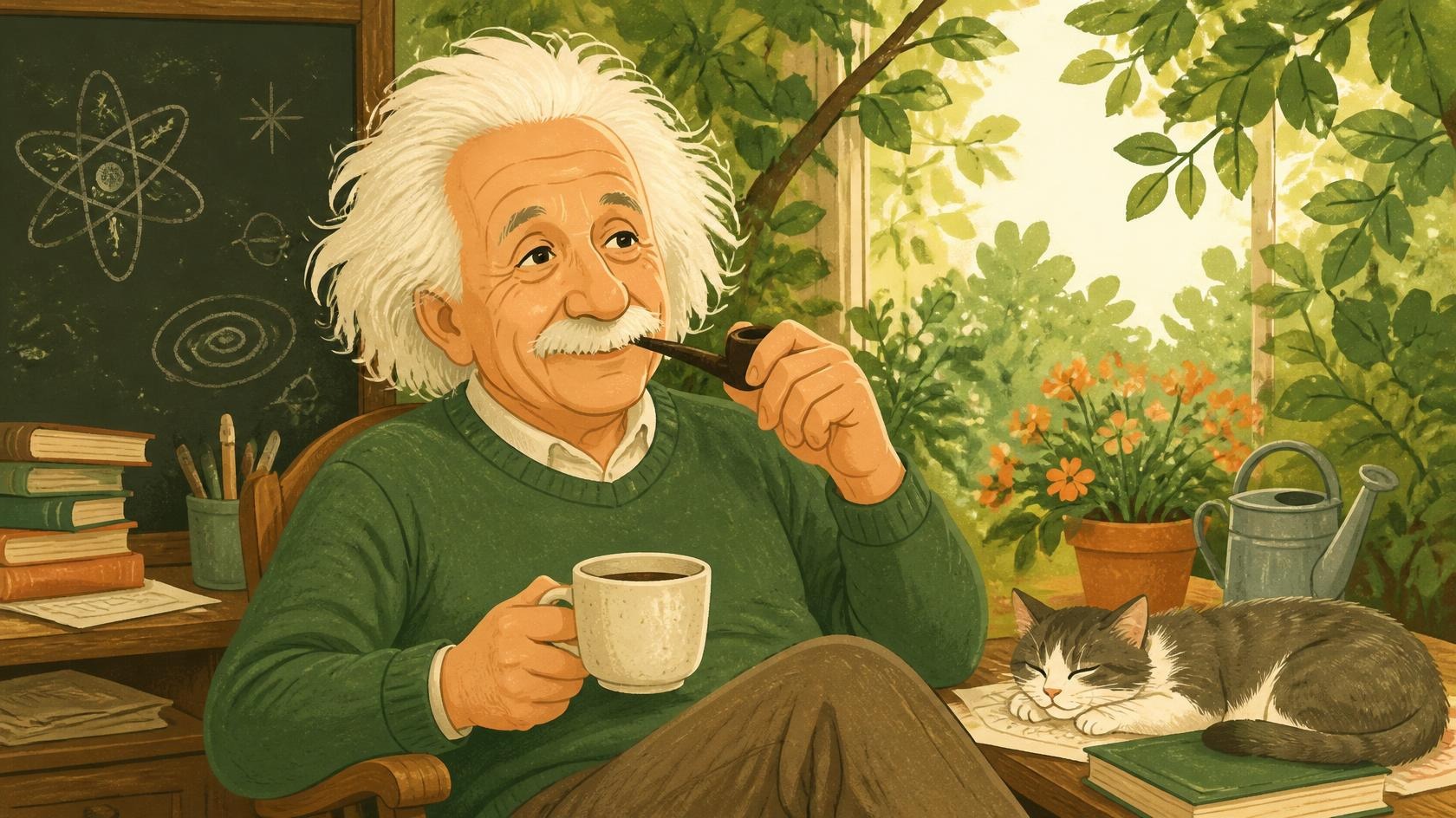
Albert Einstein’s life lessons, seen by someone who doesn’t love numbers
Math and I have never gotten along, and the theory of relativity remains, for me, a mystery as fascinating as it is impenetrable. Yet Albert Einstein is one of the figures I turn to most often when I need inspiration. This morning I read a piece on Studenti.it about his life lessons for being happier without ceasing to be ourselves, and it felt like the right moment to line up what I have been carrying with me from the German-born physicist for years: seven ideas, plus the one I consider the most precious.
Success or value: the quote that stays with me
Of all the sayings attributed to Einstein, this is my favorite:
Don’t aim for success; aim to be a person of value.
Freely adapted from Albert Einstein, LIFE, 1955
It is a paraphrase. The original appears in an interview by William Miller published in LIFE on May 2, 1955, a few weeks after the scientist’s death: “Try not to become a man of success, but rather try to become a man of value.” I chose a gender-neutral version because the idea applies to everyone, and I like to think he would phrase it that way today.
This principle has shaped my professional choices too. I spent two and a half years as a freelancer, partly to avoid compromising with job offers that promised brilliant careers without saying a word about people, a topic I covered in Job listings out of focus. When a job description finally put the people doing the work at its center, I changed my mind. Success, if it comes, is a consequence; value is something to cultivate every day.
Choosing where to invest our energy
The first lesson is about time. We can’t devote ourselves to everything with the same intensity, and chasing every expectation others place on us is the fastest way to scatter ourselves. Recognizing what truly matters means accepting that some things get left behind, without guilt. For someone like me, who always has more projects than hours, it is a daily exercise even before it becomes a rule.
Loving a passion without excelling at it
Einstein loved sailing, even though he wasn’t an expert sailor and, according to his biographers, couldn’t even swim. In 1929, for his fiftieth birthday, friends gave him a boat, the Tümmler, which he took out on the lakes around Caputh, just outside Potsdam. He also played the violin as an amateur, purely for the pleasure of it.
In my own way, I see myself in this one: I love Einstein without understanding his equations. A passion doesn’t need results to make sense; the joy it brings is enough.
Seeing problems as puzzles to solve
Faced with an obstacle, the temptation is to think we won’t make it. Einstein approached scientific questions as riddles, shifting perspective until a way out emerged. In everyday life, the same attitude turns a project gone wrong into a question still open. I wrote about this in Why failure feels so good: a mistake observed with curiosity teaches more than many victories.
Curiosity that never fades
“I have no special talents. I am only passionately curious,” Einstein wrote in 1952 to his biographer Carl Seelig. For much of his life he pursued a theory capable of unifying the forces of nature, without ever getting there. Still, he never stopped asking questions. I find that comforting: not every search has to end at a finish line, and the satisfaction can lie entirely in the journey.
Standing up for your ideas without being swept away by anger
Einstein took positions on pacifism, nationalism, and civil rights, often paying a personal price. His example shows that holding strong convictions doesn’t mean turning every exchange into a fight. Scrolling through the comments under any post is enough to see how quickly disagreement turns into aggression, a dynamic that has led many people to stop posting altogether, as I describe in Posting zero, social like TV. Listening and reasoning, even in disagreement, takes us further than any knee-jerk reaction.
Thinking for yourself, not with the majority
In 1901, in a letter to Jost Winteler, a barely twenty-something Einstein wrote that blind faith in authority is the greatest enemy of truth. In the age of fake news, a claim repeated thousands of times ends up seeming credible simply because it is everywhere. Thinking independently means checking sources, questioning our own certainties, and accepting that we might be wrong, without contradicting others just for the sake of it.
Knowledge as a right: Einstein at Lincoln University
In May 1946, Einstein visited Lincoln University in Pennsylvania, the first degree-granting historically Black university in the United States. There he received an honorary degree, gave a lecture on relativity, and called racism “a disease of white people,” declaring that he did not intend to stay quiet about it. At a time when famous figures avoided taking a stand, the gesture carried enormous weight. The message still holds: studying and understanding the world should never depend on anyone’s income or background.
Why value matters more than success
Rereading these ideas, I notice a common thread: Einstein tried to be useful, curious, and consistent rather than victorious. Perhaps that is why, more than seventy years after his death, he still inspires even those of us who get lost in front of an equation. Being happy doesn’t require becoming someone else: it is enough to choose, every day, to be of value to the people around us.
Related sources
- Non devi essere perfetto per essere felice: le 7 lezioni di vita di Albert Einstein, Studenti.it
- Try Not To Become a Man of Success But Rather Try To Become a Man of Value, Quote Investigator
- Albert Einstein, civil rights activist, Harvard Gazette
- Einstein’s beloved sailboat, Caltech Magazine
- Albert Einstein, Wikiquote
