
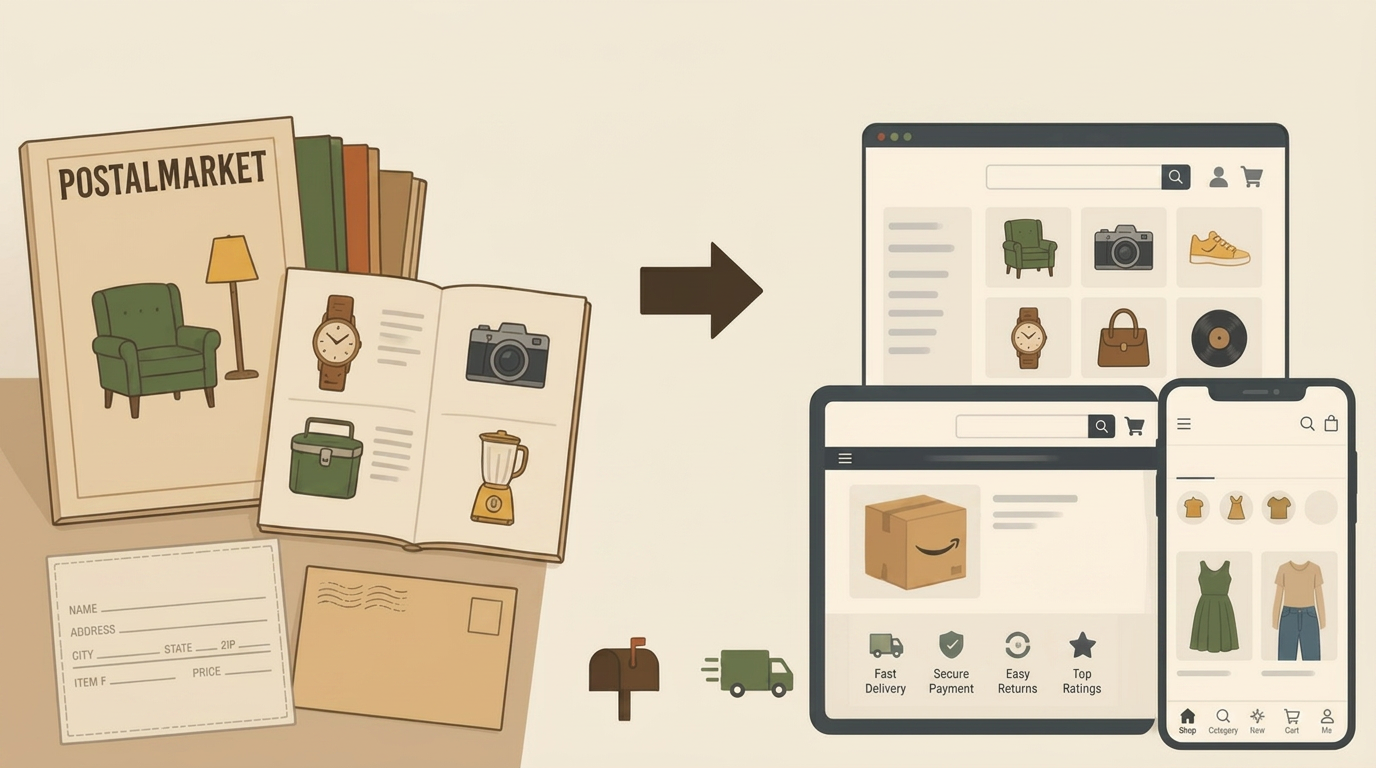
I still remember the thud of the Postalmarket catalog landing on my grandmother’s doormat, twice a year, often a few days later than the feverish anticipation the neighbors on her landing had already built up for it. That glossy brick of a book, with models on the cover and pages that still smelled of fresh paper, was an early taste of something we now take for granted: buying something without leaving the house, flipping through pages instead of walking down aisles. Decades later I do the same thing scrolling a feed on my phone, yet the underlying idea has barely changed. What has shifted is the speed at which the desired item reaches the door, and the trust (often misplaced) in what I will actually find inside the box.
Postalmarket, the catalog that landed at my grandmother’s door
Postalmarket was founded in 1959 by Milanese entrepreneur Anna Bonomi Bolchini, designed to reach families living far from big city stores. The mechanism was simple: flip through the catalog, pick a piece of clothing or an appliance, order by mail or phone, pay cash on delivery to the courier, with a “satisfied or refunded” guarantee acting as a psychological safety net. The slogan “con Postalmarket sai, uso la testa” (roughly, “with Postalmarket you know you’re using your head”) became part of Italian collective memory through television commercials, and throughout the 1980s the company handled tens of thousands of daily shipments, with revenue approaching six hundred billion lire.
Decline set in with the rise of hypermarkets and a VAT increase, both of which eroded the price advantage the whole model relied on. After being sold to the German giant Otto Versand in 1993 and surviving several attempted relaunches, the company officially went bankrupt in 2015; its last paper catalog had already come out back in 2001. In 2021 the brand returned in digital form, proof that nostalgia, dosed carefully, can still sell.
DMail and the miniature tools my mother bought
A few years later, the baton passed to catalogs like DMail’s, a company that for more than thirty years has offered household gadgets and gizmos through leaflets, a call center and, more recently, an e-commerce site paired with branded stores. My mother bought a set of work tools there for her father: in the pictures they looked sturdy, ready for serious repairs in a workshop. What arrived was miniature, almost toy-sized, good at most for tightening the screw on a pair of glasses.
The episode, retold in the family for years as an embarrassing anecdote, now feels oddly familiar to anyone who scrolls social media and stumbles across dozens of videos of people unboxing parcels from Chinese marketplaces, expecting a full-size object and finding a doll-sized one instead. The pattern has an explanation that is anything but folkloric: by shipping low-value parcels directly to the consumer, platforms such as Temu and Shein manage to stay under customs de minimis thresholds (150 euros in the European Union, 800 dollars in the United States), cutting costs and the margin for perceived error. A European investigation into the toy sector found that eighteen out of nineteen items purchased on Temu carried concrete safety risks, a figure that takes some of the fun out of the memes. The blog has returned to this topic more than once, for example in the piece on Chinese marketplaces under fire and the one dedicated to shrinkflation hitting your cart, a cousin of these downsized surprises.
eBay’s early monopoly and the Backstreet Boys tune
Before Amazon became synonymous with online shopping, undisputed dominance belonged to eBay. Founded in 1995 by Pierre Omidyar under the name AuctionWeb (the first item ever auctioned was, fittingly, a broken laser pointer sold for fifteen dollars), the site went through a decade of relentless growth: an IPO in 1998, the acquisition of PayPal in 2002 for a billion and a half dollars, five million registered users in Italy alone by 2007. On its twentieth anniversary, in 2015, it counted roughly 157 million active buyers and 25 million sellers worldwide.
Back then online auctions were common enough to earn a musical tribute: in 2003 “Weird Al” Yankovic released “eBay,” a parody of the Backstreet Boys’ “I Want It That Way” that recounted, with irony and mild obsession, the frenzy of last-second bidding wars over improbable knick-knacks. It was not an official ad for the platform, but a satirical song that became a small pop classic; even so, it captures how deeply that auction-based model had entered the collective imagination, better than any press release could. As fixed-price selling spread and more far-reaching rivals emerged, the center of gravity of the sector gradually moved elsewhere, leaving eBay in the role of a nostalgic giant rather than an outright leader.
Amazon and the horizontal power of a single marketplace
Where Postalmarket sold clothes and DMail sold tools, Amazon did away with the need to pick a category at all: today it lists more than 350 million products, offered by roughly 1.9 million third-party sellers who account for 62% of the overall catalog. In the United States it holds 37.6% of the e-commerce market, comfortably ahead of Walmart (6.4%) and Apple (3.6%); back in 2018, for that matter, it already controlled nearly half of American online sales, more than double the combined share of its nine largest competitors. Its 250 million Prime subscribers and nearly 500 million active shoppers give a sense of an ecosystem that stopped being a simple online store long ago, turning instead into logistics infrastructure, entertainment and cloud computing under one roof.
This horizontal reach marks the real break from paper catalogs, and even from eBay: it is no longer about picking among different suppliers for the same item, but about staying inside a single ecosystem for every need, from detergent to a streaming subscription. This shift has come up here before too, for instance when looking at live shopping as the “new” eCommerce, yet another attempt by the big players to bring the warmth of direct selling back into the digital storefront.
Data, studies and the current state of remote selling
In 2025 B2C eCommerce in Italy surpassed 62 billion euros, up 6% year over year, with 35.2 million active digital consumers according to the Netcomm Observatory at Politecnico di Milano. The most dynamic categories are Food & Grocery and Beauty & Pharma, both growing 7%, while clothing, electronics and home furnishings are expanding at a pace between 5% and 6%. These figures sit light years away from the few thousand copies of the first Postalmarket catalog, yet they speak to the same underlying need: receiving something at home that was chosen without stepping outside.
What has truly changed is the trust asked of the shopper. Someone ordering from my grandmother’s catalog waited weeks, but could count on an almost guaranteed refund if something went wrong; someone buying today from a global marketplace instead juggles a steady stream of reviews, returns and customs checks, subjects picked up again in the piece on the latest news on eCommerce returns. European authorities, for their part, have started scrutinizing non-EU marketplaces more closely, demanding greater accountability for product safety. The path from a catalog printed twice a year to an algorithm that suggests purchases every few seconds has been a long one, yet the thread running through it, from cash on delivery to the digital cart, stays remarkably consistent: the promise of shopping comfortably from home, with the occasional surprise (sometimes welcome, sometimes miniature) thrown in at no extra charge.
Related sources
- Cosa è stato Postalmarket
- Vendita per corrispondenza su catalogo in Italia
- Chi siamo, DMail
- eBay, il sito delle aste online compie 30 anni
- eBay (song), Weird Al Yankovic
- This Chart Shows Amazon’s Dominance in Ecommerce
- Amazon Statistics & Market Share 2026
- L’eCommerce B2c in Italia supererà i 62 miliardi di euro nel 2025
- L’arma segreta di Shein e Temu
