
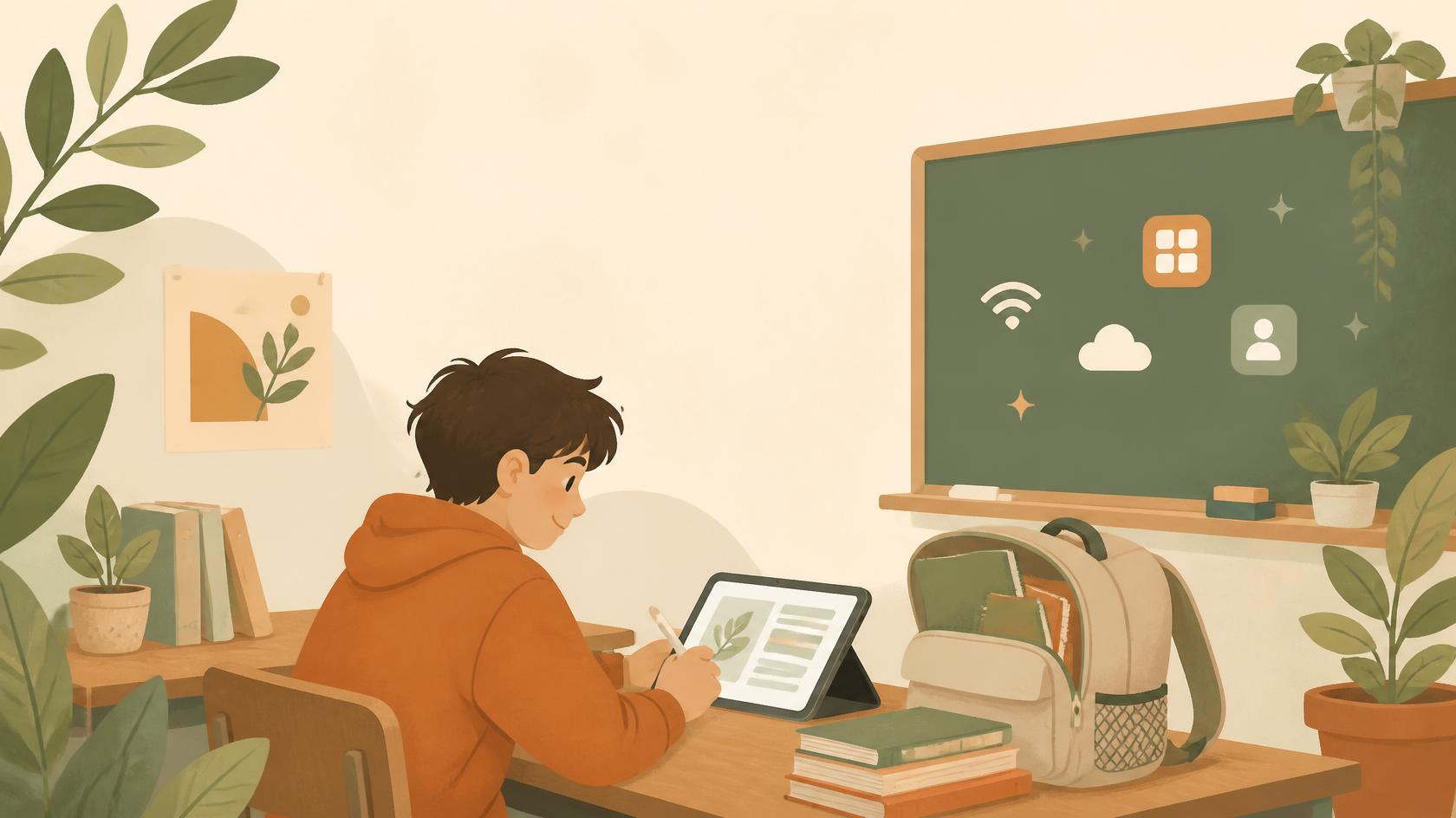
Every morning my son leaves the house with a surprisingly light backpack. No more history tomes or geography atlases stuffed between notebooks: his middle school runs on a personal tablet, brought from home under a bring your own device policy, that replaces most of the printed textbooks. It’s a small daily detail, but it says a lot about where school digitalization stands in Italy: pockets of real innovation exist, while the rest of the system limps along between unspent funds, cultural pushback and gaps that Covid made impossible to ignore.
The PNRR numbers on schools: funding pledged and delays on the ground
Italy’s recovery plan had earmarked nearly 21 billion euros for education, a figure later trimmed by about 800 million. On paper the goals sounded bold: new classrooms, labs, widespread connectivity, staff training. In practice, by the end of 2023 the Education mission had been carried out at just 16.8%, against a 22.1% average across the plan’s other missions. Even the School 4.0 program, worth 2.1 billion and meant to turn classrooms into modern learning spaces, shows formal commitments around 90% but actual payments stuck at 55%: projects get approved, the money sits parked. Even the “Connected Schools” initiative, which aims to guarantee at least 1 Gbps of internet in every building, has had to push its completion date from 2025 to 2026.
The causes behind these slowdowns are well known and keep repeating: complicated tenders, a shortage of qualified administrative staff especially in the South, changes of government that break the continuity of projects, and too few trainers able to guide real innovation. It isn’t merely a funding shortfall, but a gap in turning that money into results teachers and students can actually feel. What holds true here applies to other sectors too: I wrote a few weeks ago about the digitalization of tourism, a field where well-targeted tech investment has produced measurable results far more quickly.
Covid and the digital divide it widened
When schools shut their doors in the spring of 2020, remote learning became the clearest test of inequalities that already ran through the system. Istat, Italy’s national statistics office, flagged that a meaningful share of students had no direct or indirect access to devices such as tablets, laptops or smartphones fit for following online lessons. Internet coverage, in turn, wasn’t uniform across the country: in less developed and peripheral areas, connectivity troubles piled on top of family circumstances that often lacked the cultural resources to support kids studying from home.
The comparison with other European countries didn’t flatter national pride: several analyses found Italy’s pandemic-era digital gap wider than the one observed in France, Germany and Austria. The pandemic, in short, didn’t invent the problem from scratch: it simply dragged years of underinvestment and postponed priorities into plain sight.
What Italian classrooms actually have: connectivity and devices
The latest figures from the Osservatorio Scuola Digitale, based on a survey that 96% of Italian schools answered, paint an uneven picture. On average 81% of schools rate their internet connection as adequate for teaching needs, but that figure hides sharp regional gaps: only seven regions clear the higher adequacy thresholds, while eleven fall below 80%. On the hardware side, there are just 18 devices per 100 students at primary level and 23 at secondary level, numbers that make daily tech use hard for anyone who can’t bring their own from home.
Some 94% of schools have written digital skills activities into their three-year plans, yet funded training in STEM subjects reached only 29% of primary schools and 13% of secondary ones. And 67% of schools admit that fewer than half their teaching staff joined the training programs on offer. The European picture confirms Italy’s struggle: among 16 to 24 year olds with basic digital skills, Italy sits at 68.5%, against an EU average of 74.6%. Brussels’ 2030 target, 80% of the population with basic digital competence, still looks distant given that, among 16 to 74 year olds, Italy currently reaches just 54.3%.
Why so many teachers stay skeptical (and what my son’s school reveals)
Back to my son’s middle school, because it’s a useful case for understanding where the friction starts. The personal tablet lightened his backpack in a literal sense as well as a figurative one: no more paper textbooks to lug back and forth, materials that stay current, homework handed in with a click. And yet, among teachers, resistance runs deep, not always for reasons tied to teaching itself. Some treat it almost as a matter of principle, a blanket refusal that has little to do with how effective the tool actually is and much to do with a habit of teaching a certain way.
Research on the topic points to recurring causes: frontal lessons are seen as more rigorous and serious than active teaching methods, which sometimes get dismissed as shallow or undemanding. On top of that sits training that’s often lacking: many teachers face digital tools without adequate preparation, which breeds insecurity and, in turn, rejection. The issue, then, is rarely the device itself, but how it gets woven into daily practice and how much confidence a teacher has in handling it.
Running a classroom with new tools takes patience and openness, not unlike balancing what kids need with what a team needs: clear rules, consistency and a willingness to adapt without losing your grip on the room.
The examples that work: BYOD and active teaching methods
Fortunately, there’s no shortage of success stories. Several teachers who’ve adopted bring your own device report tangible results when the smartphone or tablet gets used actively, to support learning rather than just standing in for a notebook. The real difference, in these cases, isn’t owning the gadget but the method built around it: cooperative learning, where the teacher becomes an organizer and facilitator of group work, and learning by doing, where concepts get absorbed through hands on experience, rank among the most common approaches in Italian schools according to the Osservatorio Scuola Digitale. Primary classrooms often add circle time, an inclusive peer discussion format; high schools lean on structured debate, a strong tool for sharpening critical thinking.
These experiences show that technology, on its own, changes nothing: it becomes a real lever only when it accompanies a rethink of how teaching happens, putting students at the center of the process instead of leaving them as passive listeners.
What it would take to speed things up
Looking at the data gathered so far, a few priorities stand out. Finishing gigabit connectivity in every school building on schedule, with no further extensions, remains the first step: there’s no talking about teaching innovation in classrooms without a stable network. Next comes speeding up payments for projects already approved, closing that gap between formal commitments and funds actually disbursed that currently stalls everything. A coordinated strategy across the various funding calls, rather than fragmented measures that overlap each other, would help steer investment where it matters most.
But the trickiest piece is training: without mandatory, ongoing updates for teaching staff, digital tools risk sitting unused at the back of a cupboard. More support should also go to the parts of the country struggling most, where the regional gap, already wide before the pandemic, keeps weighing on students’ opportunities. Involving families in choosing the tools, as happens in the most successful bring your own device models, can also ease resistance and spread the costs more fairly between schools and communities.
I’ll admit that, watching all this, I sometimes think about jumping back in and teaching myself: I’d have the qualifications for it, and I’m confident I’d bring a different approach into the classroom, one that lets technology and learning coexist without any reverence or fear. Then I stop myself, because I worry it would be unfair to the kids: teaching isn’t my calling, and they’d deserve someone who lives that job with a passion I simply don’t have. What stays with me, though, is the conviction that, with the right tools in the right hands, a classroom could produce something remarkable.
Related sources
- Il PNRR Scuola non decolla: ritardi e tagli che pesano sull’attuazione, Agenda Digitale
- Competenze digitali dei giovani: il divario italiano rispetto all’Europa, Orizzonte Insegnanti
- Covid-19 e didattica a distanza: come nascono le disuguaglianze a scuola, Amnesty International Italia
- Smartphone in classe: le esperienze virtuose di BYOD, intervista a Lorenzo Redaelli, Orizzonte Scuola
- Connettività, risorse digitali e nuove metodologie didattiche: i dati dell’Osservatorio Scuola Digitale, Fondazione Leonardo
- La digitalizzazione nelle scuole: potenziale non sfruttato e nuove sfide, IRPA
