
What the Euronews article actually says
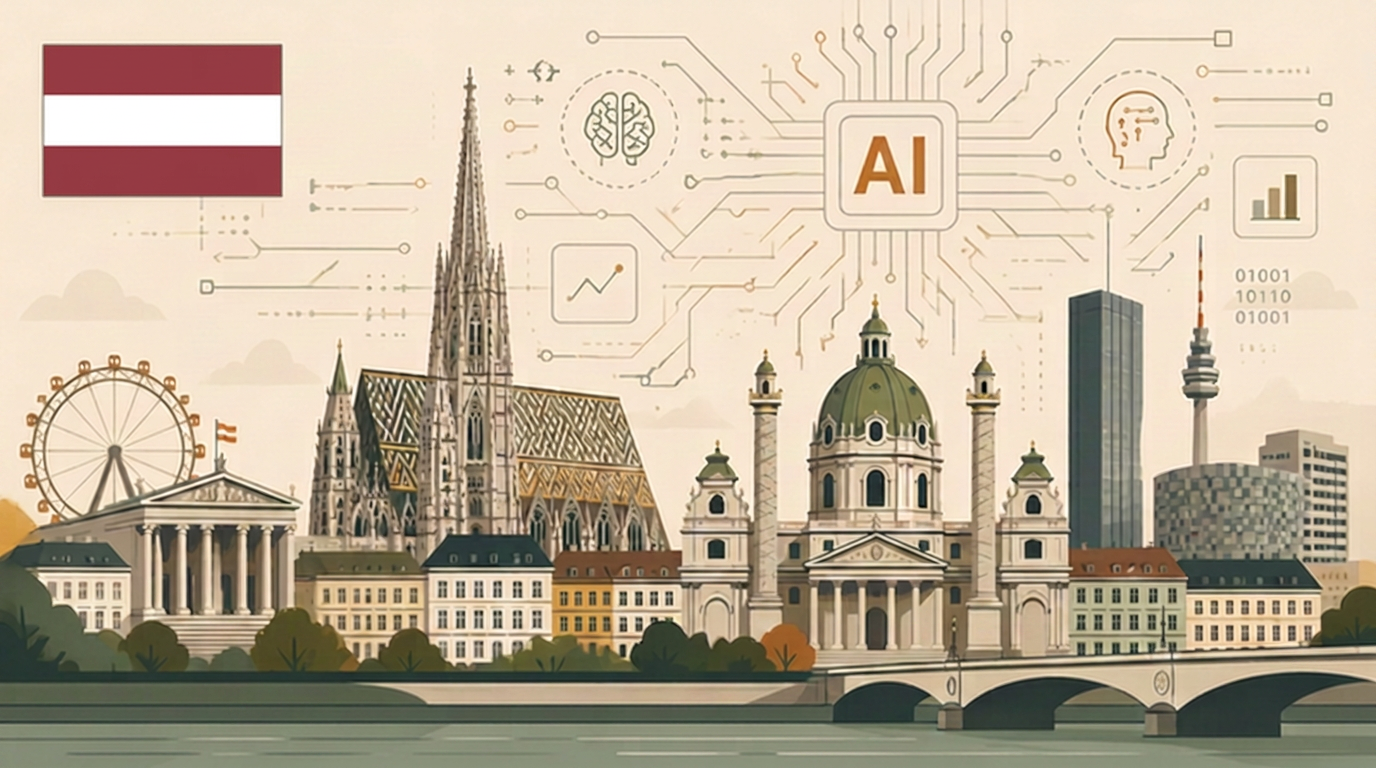
A few weeks ago Euronews ran a piece with a rather bold headline: Austria had become Europe’s hottest artificial intelligence market. I read it twice, because I once travelled around Austria to prepare my thesis, and what stuck with me was a tidy, green country full of historic cafés and bicycles parked on every corner. Cutting edge is not the phrase that would have come to mind.
The figures, though, hold up. Since January 2026 the Vienna index, the ATX, has gained 21.3%, the best performance among eurozone markets: ahead of Italy’s FTSE MIB (16.1%), the Netherlands’ AEX (15.5%) and Spain’s IBEX 35 (11.5%). By comparison, the Euro Stoxx 50 managed only 8.2%. A gap wide enough to explain why financial outlets suddenly started paying attention to Vienna.
A single company behind the record
Here’s the detail that reframes the whole story: that lead doesn’t come from a broad wave of startups, but from one company, AT&S (Austria Technologie & Systemtechnik), headquartered in Leoben, a town of roughly 24,000 people in Styria that rarely makes it into a travel guide.
AT&S shares climbed 459% year to date, moving from €32.20 to €174 by 18 July 2026, while market value jumped from €1.25 billion to around €7 billion. The firm manufactures integrated circuit substrates: components that provide mechanical support and thousands of microscopic electrical connections for the processors powering advanced AI systems. It’s a segment historically dominated by Japanese rivals such as Ibiden and Taiwanese ones like Shinko Electric, where Styria now stands as Europe’s only major manufacturer.
Full-year 2025/26 results back up the trend: revenue of €1.8 billion (up 21%), EBITDA of €418 million (nearly 50% higher) and free cash flow that turned positive again at €236 million, after several rough years. In June 2026 came fresh agreements with AMD and Intel to expand production at plants in Malaysia and China, worth an estimated €1.5 to €2 billion. Inside the iShares MSCI Austria ETF, the company went from a marginal presence to the fourth-largest holding, at a 5.9% weighting.
Why my memory and the headlines don’t actually clash
This is where the thesis comparison becomes useful. I spent most of my time between Vienna and a handful of smaller towns, certainly not Leoben, and that says a lot about how these industrial success stories tend to work: they stay invisible to anyone visiting as a tourist, because they cluster in specific districts, often far from the usual routes, tied to supply chains a general audience rarely runs into. The real shift involves one electronics plant, already decades old, that ended up in the right spot along the global chip supply chain just as demand for AI infrastructure exploded everywhere, far more than an entire nation suddenly turning into a tech capital overnight. I’ve written before about how much of AI’s sustainability rests on these hidden links in the chain, often more decisive than the language models that make the front page.
Vienna is still building a scene of its own, but that’s a separate story
To be fair, the capital isn’t sitting idle: events like ViennaUp and initiatives such as AI Hub Vienna are working to build a genuine startup ecosystem around artificial intelligence, complete with funding, incubators and a growing network of researchers. It’s a real phenomenon, just on a different scale from the stock rally tied to AT&S, and one that takes longer to mature. It reminds me a bit of what I noticed while writing about eastern Europe’s tech talent: certain pockets of excellence grow far from the spotlight, in places nobody would consider obvious, until someone actually checks the numbers.
What’s left of the story, in the end
The most interesting takeaway, for anyone who works with communication and markets the way I do, is that a punchy headline can be accurate in its figures and still misleading in the impression it leaves. The orderly, slightly old-fashioned country I got to know during my thesis still feels much the same as it did back then, nowhere near the Silicon Valley comparisons some outlets have reached for. It’s just that a valley in Styria now produces the pieces that end up inside the world’s most sought-after chips, and that alone was enough to move an entire continent’s indices. Worth remembering next time a headline seems to describe a whole nation’s sudden transformation: sometimes, behind it, there’s simply one company that did its job remarkably well.
