
Building a Content System with AI
Content management systems used to be glorified filing cabinets. You wrote something, tagged it, published it, and hoped for the best. The CMS handled storage and delivery; everything else, strategy, optimization, personalization, and governance, was on you and your team.
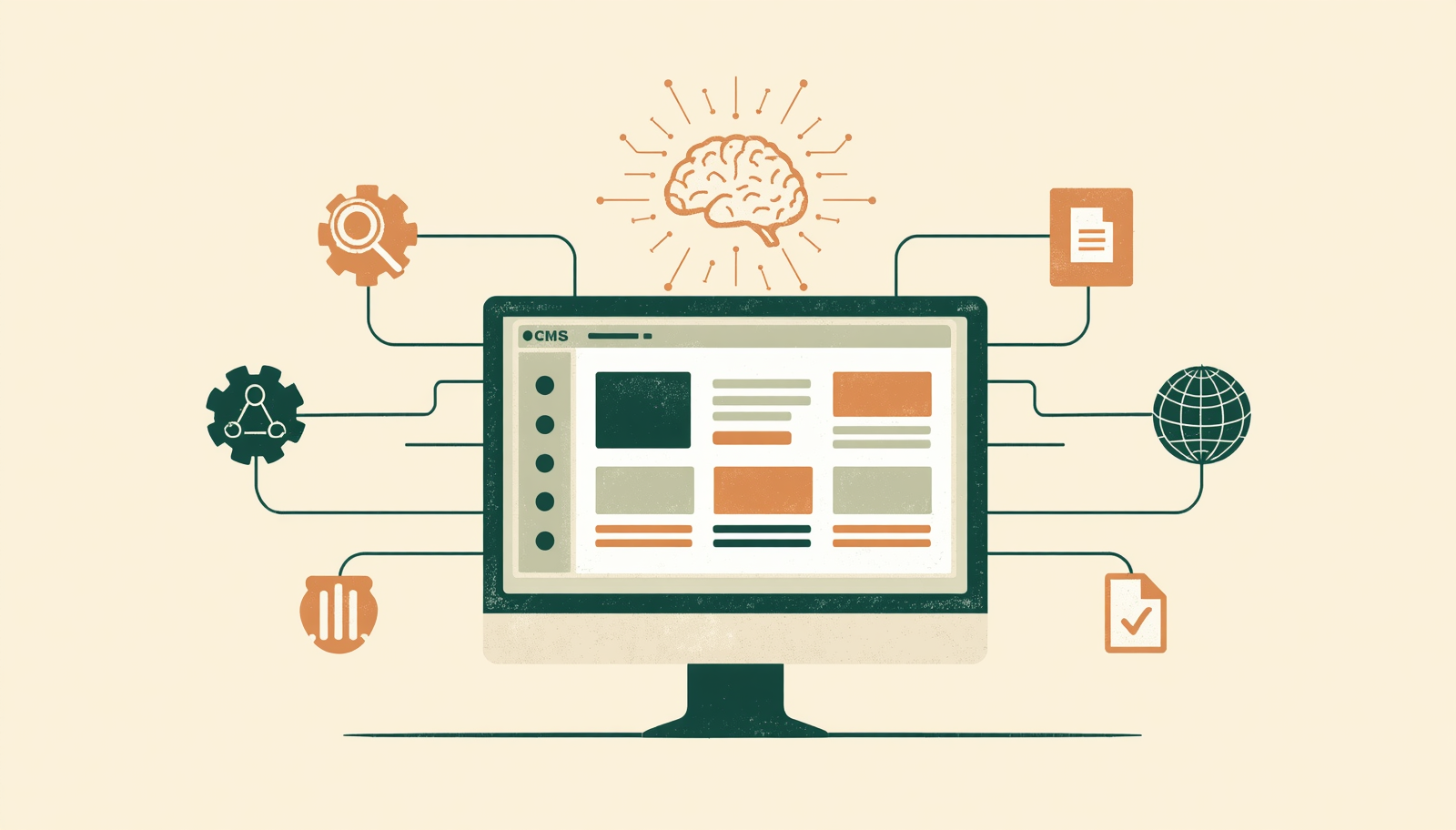
That model is breaking down. As organizations scale their digital presence across websites, apps, email, social, and now AI-powered search interfaces, the old publish-and-pray workflow can’t keep up. AI isn’t just being bolted onto content management systems as a feature; it’s fundamentally reshaping what a CMS is, what it does, and who it serves.
This article explores how AI is transforming the CMS from a publishing tool into an intelligent content operating system, drawing on insights from UX Content Collective’s work on AI content strategy, UX Collective’s research on AI interface patterns, and real-world case studies from enterprises navigating this shift.
From Publishing Tool to Content Operating System
The most significant shift in the CMS landscape isn’t a new feature; it’s a change in category. Enterprise CMS strategy in 2026 is moving from page publishing to orchestrating content across brands, channels, and regions with measurable governance and speed. Platforms like Sanity now describe themselves not as a “headless CMS” but as a “Content Operating System,” reflecting the idea that content management has become a systems-level discipline.
AI accelerates this shift in three ways. First, it automates the mechanical work that slows teams down: tagging, metadata generation, content classification, and workflow routing. Second, it enables real-time personalization, adapting what users see based on behavior, context, and intent, without requiring manual segmentation. Third, and most profoundly, it changes the nature of content itself. In a world where AI Overviews, chatbots, and generative search interfaces consume and repackage your content, a CMS must treat language not just as something to display, but as structured data that machines can parse, retrieve, and cite.
UX Content Collective captures this evolution precisely: the new responsibility of content professionals includes “structuring language as data, not just organizing it in a CMS” and “building content flows around model retrieval and inference, not just user navigation.” This is a fundamental reorientation. The CMS is no longer just the place where humans write for humans. It’s the infrastructure that feeds both human interfaces and AI systems.
AI Across the Content Lifecycle
AI’s impact on content management isn’t confined to a single stage. It reaches across the entire content lifecycle, from planning through creation, management, distribution, and measurement.
Planning and Strategy
AI-powered CMS platforms now analyze competitor content, search queries, and existing content libraries to identify strategic gaps. Rather than relying on editorial intuition alone, content teams can use AI to surface opportunities: topics that competitors haven’t covered well, questions users are asking, but no one is answering, and content that has decayed in relevance and needs refreshing. This kind of intelligence, integrated directly into the CMS rather than requiring separate tools, allows strategy and execution to live in the same environment.
Creation and Authoring
Generative AI has transformed the authoring layer. Modern AI CMS platforms embed content generation tools directly into the editorial workflow, so editors can draft, expand, rewrite, and translate content without leaving the interface. HubSpot’s “Breeze” AI, for instance, can take a single blog post and transform it into emails, podcast scripts, and social media posts. WordPress with the Jetpack plugin adds AI writing assistance and even code generation for front-end customization.
But the UX Content Collective sounds a critical caution: “There is a significant caveat to using AI for content creation. That is to ensure the content created is accurate, in the required style, compliant where needed, and clear. Care must be taken when writing prompts for AI, and a person will have additional context and knowledge about business goals and user needs that AI will not.” AI accelerates creation, but human judgment remains the quality gate.
Management and Governance
This is where AI’s value compounds quietly but powerfully. Traditional content operations relied on manual review, someone checking every string, enforcing style by hand, catching inconsistencies post-publication. AI introduces what UX Content Collective calls “system-level control”: style guide copilots trained on your brand’s standards that flag inconsistencies during writing, automated compliance checks that catch missing disclosures or accessibility violations, and intelligent categorization that keeps sprawling content libraries navigable.
For enterprise teams managing thousands of content assets across multiple brands and regions, this isn’t a nice-to-have. It’s the difference between content operations that scale and ones that collapse under their own weight.
Distribution and Personalization
AI-powered CMS platforms track user behavior in real time and adjust content for relevant audience segments. This goes beyond basic A/B testing. Modern systems can determine the optimal timing, frequency, and channel for distributing content to maximize reach and engagement, optimizing distribution across websites, social media, email, and emerging channels such as AI search interfaces.
The rise of Generative Engine Optimization (GEO) introduces an entirely new distribution layer. Content is no longer just delivered to users; it’s consumed by AI systems that synthesize answers for search queries. A CMS that structures content with clear metadata, schema markup, and semantic tagging makes it more likely that AI systems will cite your content in their generated responses.
Measurement and Optimization
AI-driven analytics tools integrated into the CMS provide insights that go beyond pageviews and bounce rates. They can assess content performance against intent satisfaction, predict which content will become less relevant, and recommend optimization actions. Predictive content performance insights enable teams to be proactive rather than reactive, updating content before it loses its ranking potential, not after.
Case Study: Content Design at Scale
One of the most compelling illustrations of AI’s impact on content management comes not from a CMS vendor, but from the content design community itself.
UX Content Collective documents how content designers are being drawn into AI development processes at companies such as OpenAI and Anthropic. Their role has expanded from writing interface copy to shaping the systems that generate language at scale. This includes writing system messages (the background instructions that shape how an AI model responds), structuring training data, designing prompt architectures, and evaluating model outputs against UX quality standards.
As UXCC describes it: “Content designers are moving upstream in the model development process. They’re helping define what good output looks like. They’re shaping the inputs that drive LLM behavior. A growing number are partnering directly with AI teams to structure training data and system prompts.”
This shift has direct implications for CMS architecture. If content designers are now responsible for designing the rules that govern AI-generated content, voice, tone, accuracy, and compliance, then the CMS must support this new type of authoring. It needs to store not just finished content, but the frameworks, prompt libraries, and evaluation criteria that produce it. A mature AI-driven content strategy, as UXCC puts it, “includes frameworks, content models, prompt libraries, and evaluation systems. It aligns the system’s language with product goals, user needs, and safety standards.”
The Wix product team offers a concrete example: they’ve been building AI agent skills specifically for product and UX content design work, embedding content governance directly into the tools that generate content. This approach, rules that enforce themselves automatically, represents the next evolution of CMS governance.
The Enterprise Reality Check
The industry narrative around AI-powered CMS can make the transformation sound effortless. The reality, as CMSWire’s 2025 year-in-review analysis made clear, is more nuanced: “AI did not break digital experience platforms, it revealed their limits.”
Organizations discovered that AI capabilities only translate into better outcomes when they operate inside reliable delivery pipelines spanning content, data, workflows, and governance. Fragmentation that was once manageable became expensive when AI models needed consistent data access, shared context, and reliable orchestration.
A B2B SaaS company that migrated from a monolithic CMS to a headless Contentful setup saw a 48% improvement in time-to-publish and a 32% lift in organic traffic, but that result required integrating the CMS with their CRM, analytics stack, and rebuilding the site on a modern architecture. The AI-powered features were the accelerant; the plumbing was what made it work.
Similarly, ADWEEK’s migration to WordPress VIP delivered 100% site uptime during the 2025 Super Bowl, tripled its content-creation output, and drove an 82% surge in site traffic. But the key wasn’t AI alone; it was the combination of AI-assisted workflows with enterprise-grade infrastructure, governance, and editorial discipline.
What UX Design Tells Us About AI in CMS
UX Collective (uxdesign.cc) has been exploring a question that’s deeply relevant to the CMS discussion: where should AI sit in the interface? Sharang Sharma’s analysis of emerging AI UI patterns maps several models: AI as a sidebar assistant, AI as an embedded agent, and AI as the grid itself, and each has direct implications for how content management interfaces will evolve.
The pattern that most resonates with modern CMS design is what Sharma describes as the “deep-context expert”: AI that delivers targeted, reasoning-driven support without dominating the experience. In a CMS context, this means AI that suggests optimizations, flags compliance issues, and generates draft content, but always within a workflow controlled by human editors. The AI makes the human faster and more consistent; it doesn’t replace editorial judgment.
This aligns with UX Content Collective’s core philosophy: “AI isn’t the goal, it’s a tool. The best way to use AI is by connecting it with UX writing best practices.” Content designers, they argue, “have a natural advantage when using AI” precisely because they understand language, context, and user intent, the qualities that separate useful AI outputs from generic slop.
Building for What’s Next
The CMS of 2026 must serve multiple audiences simultaneously. Marketers need visual editing and workflow automation. Developers need APIs, extensibility, and modern deployment pipelines. Content designers need prompt libraries, evaluation frameworks, and governance tools. And increasingly, AI systems need structured, semantically rich content they can retrieve, interpret, and cite.
No single AI feature makes a CMS “intelligent.” Intelligence comes from the integration: content models that treat language as structured data, workflows that embed quality checks at every stage, analytics that connect content performance to business outcomes, and architecture that delivers content to any channel, including the AI systems that are becoming channels themselves.
The organizations getting this right aren’t necessarily the ones with the most advanced AI features. They’re the ones that invested in the boring work first, clean content models, consistent metadata, governed workflows, clear editorial standards, and then layered AI on top of a foundation that could actually support it.
As one CMS industry analysis put it, “agentic AI is only as good as your content and data.” The smartest AI in the world can’t fix a broken content architecture. But a solid content architecture, enhanced by AI, can transform how organizations create, manage, and deliver the experiences that matter.
Sources
- UX Content Collective, “How to Use a UX-First Approach with AI Content Strategy” (June 2025) — https://uxcontent.com/ai-content-strategy/
- UX Content Collective, “How Is UX Writing Impacted by AI?” (April 2024) — https://uxcontent.com/how-is-ux-writing-impacted-by-ai/
- UX Content Collective, “How to Use AI in the UX Writing Process” (May 2023) — https://uxcontent.com/how-to-use-ai-in-the-ux-writing-process/
- UX Content Collective, “AI Evaluation for Content Design” (May 2025) — https://uxcontent.com/ai-evaluation-content-design/
- UX Content Collective, “How I Built an AI Tool That Does Real Content Design” (May 2026), featuring Wix product team AI agent skills — https://uxcontent.com/ai-content-design-tool
- Sharang Sharma, “Where Should AI Sit in Your UI?” UX Collective / uxdesign.cc (June 2025) — https://uxdesign.cc/where-should-ai-sit-in-your-ui-1710a258390e
- CMSWire, “AI Entered the Digital Experience Stack in 2025. Reality Set the Terms.” (February 2026) — https://www.cmswire.com/digital-experience/ai-entered-the-digital-experience-stack-in-2025-reality-followed/
- WordPress VIP, “How ADWEEK Achieved 100% Site Uptime During the 2025 Super Bowl” (March 2025) — https://wpvip.com/case-studies/100-site-uptime-super-bowl/
- HubSpot, “Breeze AI” product documentation — https://www.hubspot.com/breeze
- Sanity, “Content Operating System” platform positioning — https://www.sanity.io
Chiara Bonifazi is a Branded Content Strategist, UX Writer, and Content Designer with over 25 years of experience in the digital industry. She helps brands bridge the gap between digital products and their audiences across cultures and languages.
